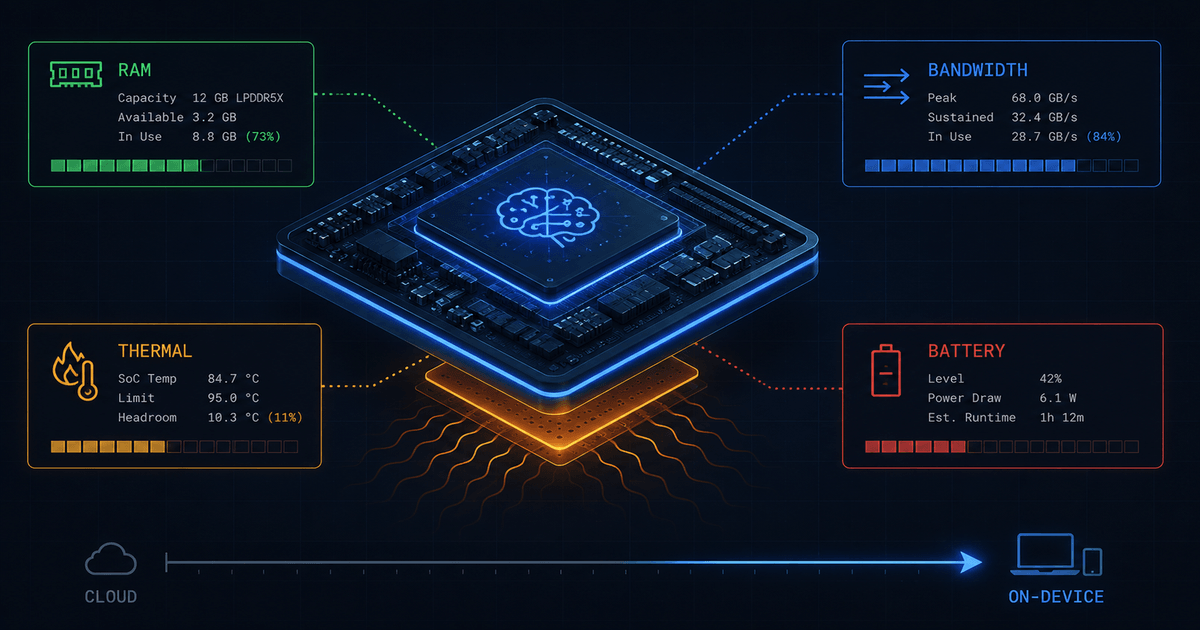
Compact AI models now run entirely on phones, laptops, and edge devices, no cloud required. Summarization, classification, extraction, rewriting, lightweight assistants: all without a round trip to a remote data center. For products that depend on privacy, speed, or offline capability, the economics have shifted. But the physics have not.
The bottleneck is no longer whether a model can technically execute on a device. It is whether the device has enough RAM, memory bandwidth, and thermal headroom to keep the experience fast, reliable, and useful under real-world conditions. That distinction separates the products that ship on-device AI users actually keep from the ones that look good in a controlled demo.
The new baseline
The conversation around on-device AI has shifted fast. Not long ago, local inference was mostly a proof of concept. Today, it is a practical baseline for products that care about privacy, latency, and offline availability.
Apple (2025) ships a ~3 billion parameter on-device foundation model with 2-bit quantization-aware training and KV-cache sharing, giving developers direct access through the Foundation Models framework. Qualcomm (2026) tests Gemma and Llama variants from 270 million to 8 billion parameters on the Snapdragon 8 Elite, achieving up to 2.9x improvement in time-to-first-token through their Matrix Extension acceleration. Google's Gemini Nano powers on-device features across the Pixel lineup, and Samsung's Galaxy AI suite runs summarization, translation, and call transcription locally on flagship devices.
These are not research experiments. They are shipping products used by hundreds of millions of people.
The product case is straightforward. Google's Scam Detection, launched in 2025, analyzes phone calls in real time using Gemini Nano running entirely on the device. Sending audio of every phone call to a cloud server would be both a privacy risk and a latency problem. On-device inference is the only viable architecture for that use case.
The economic argument reinforces the product one. Cloud inference is expensive at scale, especially when every interaction depends on GPU-backed infrastructure. Local inference shifts part of that cost to the device, where it is amortized across the user experience. For products with high-volume, repetitive, or latency-sensitive workflows, that is a material cost advantage. Cloud AI is no longer the default answer to every problem. Routine tasks are increasingly routed locally, while harder or higher-stakes requests can still be escalated to the cloud.
What the hardware can sustain
On-device AI is not just about model choice. It is about what the hardware can sustain over time. Three constraints set the ceiling, and they differ sharply by device type.
RAM is the first hard gate. A model's weights may fit on paper, but once you add runtime buffers, activation memory, and the KV cache used for attention, the total footprint rises fast. A phone with 6 GB of RAM handles a small quantized model adequately for short prompts. An 8 GB or 12 GB device feels substantially more comfortable for longer sessions or multitasking. Once RAM pressure increases, the device swaps, pauses, or throttles. Latency rises, battery life worsens, and the interface stops feeling instant.
Memory bandwidth is the binding constraint during decode. Qualcomm (2026) found that decode throughput gains from CPU acceleration are limited by memory bandwidth saturation, not compute. This is the deeper structural gap: mobile devices operate at 50-90 GB/s of memory bandwidth, while datacenter GPUs deliver 2-3 TB/s. That is a 30-50x difference. For LLM inference, where the decode phase is memory-bound, this gap is decisive. A chip with impressive peak TOPS (trillions of operations per second) can still feel slow during autoregressive generation because it is waiting on memory reads, not compute.
Thermal budget determines how long performance holds. This is the constraint most benchmarks ignore, and it matters more on mobile than anywhere else. The next section covers it in detail.
The practical ceiling differs dramatically by device class:
| Device class | Typical RAM | Cooling | Practical ceiling | Best for |
|---|---|---|---|---|
| Budget phone | 4 GB | Passive, tight | Sub-1B models, short sessions | Only heavily optimized, narrow use cases |
| Midrange phone | 6-8 GB | Passive, moderate | 1-3B quantized models | Bounded tasks: summarize, classify, extract |
| Flagship phone | 12-16 GB | Passive, better headroom | 3-7B quantized models | Longer sessions with careful memory management |
| Laptop (active cooling) | 16-32 GB | Active (fan) | 7-13B comfortably | Best sustained performance on consumer hardware |
| Edge NPU device | Varies | Dedicated silicon | Task-specific, near-zero thermal variance | Continuous inference, power-constrained environments |
Two devices with similar RAM can feel radically different running the same model. A device with a strong NPU or dedicated AI engine delivers far better performance per watt than CPU-only execution. The GPU and NPU handle the heavy parallel work of inference. The CPU still manages tokenization, scheduling, sampling, and fallback processing, but the accelerator is where sustained throughput lives. Architecture matters as much as spec sheet numbers.
The thermal ceiling nobody benchmarks
Phones, tablets, and laptops can all deliver impressive burst performance for a few seconds. The real question is what happens after sustained use.
Tummalapalli et al. (2026) benchmarked Qwen 2.5 1.5B (4-bit quantized) across four platforms under sustained load, running 20 iterations with a 258-token prompt. The results exposed a gap that no spec sheet captures.
The iPhone 16 Pro dropped from 40.5 to 23.7 tokens per second within three iterations, settling into a thermally throttled "hot state." That is a 41.5% performance loss. The Samsung S24 Ultra showed a more controlled 15% degradation through DVFS-based (Dynamic Voltage and Frequency Scaling) throttling rather than hard thermal failure. The laptop GPU (RTX 4050) held steady at 131.7 tok/s with only 2.2% variance. The Hailo-10H edge NPU showed near-zero variance at 0.04%.
When a device heats up, it throttles. The CPU or accelerator slows down to stay within thermal limits. Token generation drops, latency rises, and battery drain worsens. The user experiences this as "the model got slower," but the underlying issue is thermal management, not model quality. One-second inter-iteration gaps are insufficient for thermal recovery on smartphones.
This is why peak specs are deceptive. A fast chip with passive cooling may underperform a more balanced device during real use. The Hailo-10H NPU achieved comparable energy efficiency (0.271 W/tok/s) to the RTX 4050 (0.259 W/tok/s) despite a 19x throughput difference, because dedicated accelerators are designed for sustained parallel workloads rather than burst compute. On-device AI rewards sustained efficiency more than headline benchmarks.
Laptops with active cooling largely avoid this problem. The thermal ceiling is most punishing on phones and tablets, where passive cooling is the only option and the chassis absorbs heat with nowhere to dissipate it. For product teams, this means the same model and the same code can deliver a fundamentally different user experience depending on the thermal profile of the target device.
What you can run today, and on what
Quantization is what makes on-device AI practical. It shrinks model weights by using lower-precision numerical representations (typically 4-bit or 8-bit instead of 16-bit), reducing memory pressure and speeding inference. Modern quantization methods like Q4_K_M now preserve 95-98% of full-precision model quality on most benchmarks. Without quantization, most local deployment would not be viable on consumer hardware.
Apple (2025) uses 2-bit quantization-aware training for its on-device foundation model, an aggressive compression that keeps the model small enough to run alongside the operating system and apps without competing for memory. Qualcomm (2026) tested both INT8 and INT4 quantized formats across models from 270 million to 8 billion parameters, finding that 4-bit models shift the inference bottleneck entirely from compute to memory bandwidth.
Here is what actually runs on real hardware in mid-2026, using Q4_K_M quantization (the default sweet spot for most users):
Phones (passive cooling, 8-12 GB RAM)
| Model | Parameters | Q4 size | Runs on | Best for |
|---|---|---|---|---|
| Phi-4-mini | 3.8B | ~2.1 GB | Any phone with 6 GB+ RAM | Reasoning, code, structured tasks |
| Gemma 3 4B | 4B | ~2.5 GB | Any phone with 6 GB+ RAM | Multimodal, 140+ languages |
| Llama 3.2 3B | 3B | ~2.6 GB | Any phone with 6 GB+ RAM | General assistant, summarization |
| Mistral 7B | 7B | ~4 GB | Flagship (iPhone 17 Pro, S24 Ultra with 12 GB) | Higher-quality text generation |
| Llama 3.1 8B | 8B | ~4.5 GB | Flagship 12 GB+ (tight, short sessions only) | Best quality available on a phone |
Apple's own on-device model is ~3B with 2-bit quantization, which gives a sense of where the platform vendor draws the practical line. A recent demonstration showed an iPhone 17 Pro running Qwen3.5-397B (a Mixture of Experts model with 17B active parameters per token) by streaming weights from NVMe storage, but at 0.6 tokens per second, that is a technical proof of concept, not a usable product.
Laptops (active cooling, 16-128 GB RAM/unified memory)
| Model | Parameters | Q4 size | Runs on | Performance |
|---|---|---|---|---|
| Qwen 2.5 14B | 14B | ~8 GB | MacBook Pro M4 Pro (24 GB), any 16 GB+ laptop with GPU | ~90 tok/s on RTX 5090 |
| Qwen 2.5 32B | 32B | ~18 GB | RTX 4090 (24 GB), RTX 5090 (32 GB), MacBook Pro M4 Max (36 GB+) | ~41 tok/s on RTX 5090 |
| Llama 3.1 70B | 70B | ~39 GB | MacBook Pro M4 Max (64 GB+), dual GPU setups | ~8-12 tok/s on M4 Max 64 GB |
The RTX 5090 with 32 GB GDDR7 and 1,792 GB/s memory bandwidth (78% higher than the RTX 4090) is the current ceiling for single-GPU desktop inference. It comfortably fits 32B models entirely in VRAM and can run a Llama 3.1 8B at ~3,500 tok/s in FP16. The MacBook Pro M4 Max with 128 GB unified memory takes a different approach: lower bandwidth (546 GB/s) but far more memory, making it the better choice for running 70B+ models that simply do not fit on a discrete GPU.
Desktops and workstations (always-on, high memory)
The most interesting developments in on-device AI are happening below the data center and above the laptop. Desktop-class hardware now runs models that were cloud-only 18 months ago.
| Device | Memory | Bandwidth | Max model (Q4) | Starting price |
|---|---|---|---|---|
| Mac Mini M4 Pro | Up to 64 GB unified | 273 GB/s | ~32B comfortably, 70B tight | ~$1,999 (48 GB) |
| Mac Studio M4 Max | Up to 64 GB unified | 546 GB/s | ~70B at Q4 | ~$3,999 |
| Mac Studio M3 Ultra | Up to 96 GB unified | 800 GB/s | ~70B comfortably at Q5+ | ~$5,999 |
| NVIDIA DGX Spark | 128 GB unified | 273 GB/s | Up to 200B | ~$3,000 |
| NVIDIA DGX Station | 784 GB coherent | N/A (GB300) | 500B+ | Enterprise pricing |
The NVIDIA DGX Spark (formerly Project DIGITS) deserves special attention. Powered by the GB10 Superchip with 1 petaflop of FP4 AI performance and 128 GB of unified memory, it runs models up to 200 billion parameters locally. It ships with Ollama pre-installed and NVIDIA's full AI software stack. For teams that need local inference without cloud dependency, this is the first desktop-class device that makes 200B models a practical reality.
The Mac Mini M4 Pro at ~$1,999 (48 GB configuration) is the best value entry point for serious local inference. It runs 32B models comfortably and can handle 70B at Q4 with careful memory management. The Mac Studio pushes higher with M4 Max (546 GB/s bandwidth) or M3 Ultra (800 GB/s), making sustained 70B inference genuinely smooth.
Distributed inference: scaling beyond a single device
When a single device cannot hold the model, the next question is whether multiple devices can share the load. In 2026, the answer is yes, and the tooling has matured enough to make it practical.
Exo is the most significant open-source project in this space. It pools memory from multiple Apple Silicon devices into a single inference cluster with no master-worker architecture: every device is a peer. A cluster of Mac Minis can run a 671B parameter model by splitting transformer layers across machines. On 2 devices, Exo achieves up to 1.8x speedup. On 4 devices, up to 3.2x. The 2026 release of Exo 1.0 introduced day-zero support for RDMA (Remote Direct Memory Access) over Thunderbolt 5, collapsing inter-device latency from ~300 microseconds to as low as 3-9 microseconds, a 99% reduction.
The practical implication: four Mac Mini M4 Pro units (48 GB each, ~$8,000 total) create a 192 GB unified inference cluster capable of running Llama 3.1 70B at comfortable quality settings or pushing into 100B+ territory with quantization. That is a private, air-gapped AI capability that was data-center-only two years ago.
Petals takes a different approach. Instead of a local cluster, it distributes model layers across volunteers or team members in a BitTorrent-style network. It demonstrated that consumer GPUs can collaboratively serve BLOOM-176B by hosting different transformer blocks, achieving usable throughput on commodity hardware. The tradeoff is latency: network hops between devices add overhead that local Thunderbolt connections avoid.
Other tools worth noting: vLLM supports multi-machine clustering via the Ray distributed framework for production-grade throughput. Prima.cpp targets heterogeneous home clusters, running 30-70B models across mixed hardware (different GPUs, different generations). Ollama remains the fastest path from zero to running a local model, with a single command to install and a single command to run.
The trajectory here is clear. The combination of Apple Silicon's unified memory, Thunderbolt 5 RDMA, NVIDIA's DGX Spark, and open-source distributed inference tools means that running 100B+ parameter models privately, without any cloud dependency, is no longer an enterprise-only capability. It is accessible to small teams, research labs, and individual developers willing to invest in hardware.
The tradeoff from quantization is real. A quantized 1-3B model handles structured tasks well: summarization, classification, extraction, rewriting, and form completion. For open-ended reasoning, longer conversational memory, or subtle language work, the gap between a local quantized model and a cloud-hosted frontier model is still meaningful. Quality parity should be defined by task class. For short, bounded tasks, a local model is close enough. For open-ended, multi-step, or knowledge-heavy work, cloud models still have a clear edge.
A practical reference point: Qualcomm (2026) notes that average human reading speed is approximately 4-7 tokens per second. A device generating 10-24 tok/s during sustained inference is fast enough for interactive use on bounded tasks. The experience feels instant. The model does not need to be the fastest available. It needs to be fast enough for the task while fitting within the device's sustained thermal and memory constraints. Fit beats fame.
The hybrid architecture that ships
The future is not purely local or purely cloud. It is hybrid. The device handles instant reactions, privacy-sensitive tasks, and offline support. The cloud handles the heavier work. Users experience one product, even though the architecture beneath it is split.
This is the most credible path because it respects the real constraints. It does not pretend devices are unconstrained, and it does not ignore how valuable local inference has become. A phone that loses 41% throughput under sustained inference is not a platform for heavy reasoning. It is a platform for fast, bounded, privacy-sensitive tasks with cloud escalation for harder work.
The strongest implementations route dynamically based on task complexity, device capability, and confidence. Samsung's Galaxy AI does this transparently: on-device models handle summarization and translation locally, while more complex generative tasks route to cloud infrastructure. The user sees one interface. The routing is invisible.
A concrete example makes the framework real. Take a fitness app that summarizes workout notes on a midrange Android phone with 8 GB of RAM. The model is a 1.5B parameter model quantized to INT4. It fits in under 1 GB, completes in a single turn under 100 tokens, and the inference finishes in seconds, well within the thermal window. This runs locally. Now take the same app generating a personalized multi-week training plan based on six months of workout history. That is a multi-turn, long-context task requiring sustained inference and a large KV cache. Route it to the cloud. The user does not notice the architecture change. They notice that both features work reliably.
The decision framework reduces to five factors:
| Factor | Run locally | Route to cloud |
|---|---|---|
| Task scope | Single-turn, bounded (summarize, classify, extract, rewrite) | Multi-turn, open-ended, knowledge-heavy |
| Token budget | Completion under ~200 tokens | Longer generation or large context window |
| RAM fit | Model + runtime under 60% of available RAM | Model requires more than 60% (OS + apps compete) |
| Thermal window | Inference completes within ~60 seconds sustained | Sustained inference over 60 seconds on passive-cooled device |
| Privacy | Sensitive data that should not leave the device | Non-sensitive, latency-tolerant |
This also makes commercial sense. It reduces cloud costs where possible, protects user trust, and avoids overpromising performance that devices cannot support. In a market full of inflated claims about what on-device AI can do, restraint is a competitive advantage.
The trajectory is clear. Models will continue to shrink without losing as much capability. Hardware will get better. Tooling will improve. More of the intelligence stack will move closer to the user. What will not change quickly is the underlying physics. RAM, compute, memory bandwidth, and thermal headroom still set the limits. Devices are not cloud clusters, and no amount of marketing will change that.
On-device AI is already good enough to displace cloud inference for a meaningful class of tasks, and in the right product it delivers a better experience than a cloud-only architecture. The claim that everything can run client-side with server-quality output is still ahead of the physics. The strongest products will be the ones that put the right model on the right hardware, keep the hardest work in the cloud, and build a system the user never has to think about.
Sources
- Tummalapalli, P., Arayakandy, S., Pal, R., & Kundan, K. (2026). LLM Inference at the Edge: Mobile, NPU, and GPU Performance Efficiency Trade-offs Under Sustained Load. Conscious Engines. arxiv.org/html/2603.23640v2
- Apple (2025). Apple Intelligence Foundation Language Models Tech Report 2025. Apple Machine Learning Research. machinelearning.apple.com
- Qualcomm (2026). Boosting Llama models performance on mobile CPUs with Qualcomm Matrix Extension. Qualcomm Developer Blog. qualcomm.com/developer/blog
- NVIDIA (2026). DGX Spark Personal AI Supercomputer. NVIDIA Product Page. nvidia.com/dgx-spark
- NVIDIA (2026). DGX Spark Hardware Overview. NVIDIA Documentation. docs.nvidia.com/dgx/dgx-spark
- Exo Labs (2026). Exo: Run AI models on a local cluster of everyday devices. GitHub. github.com/exo-explore/exo
- Apple (2024). Mac Mini Technical Specifications. Apple. apple.com/mac-mini/specs
- MLCommons (2026). MLPerf Inference v6.0 Benchmark Results. MLCommons. mlcommons.org
- Hardware Corner (2026). RTX 5090 Local LLM Benchmarks, Context Scaling & Supported Models. hardware-corner.net