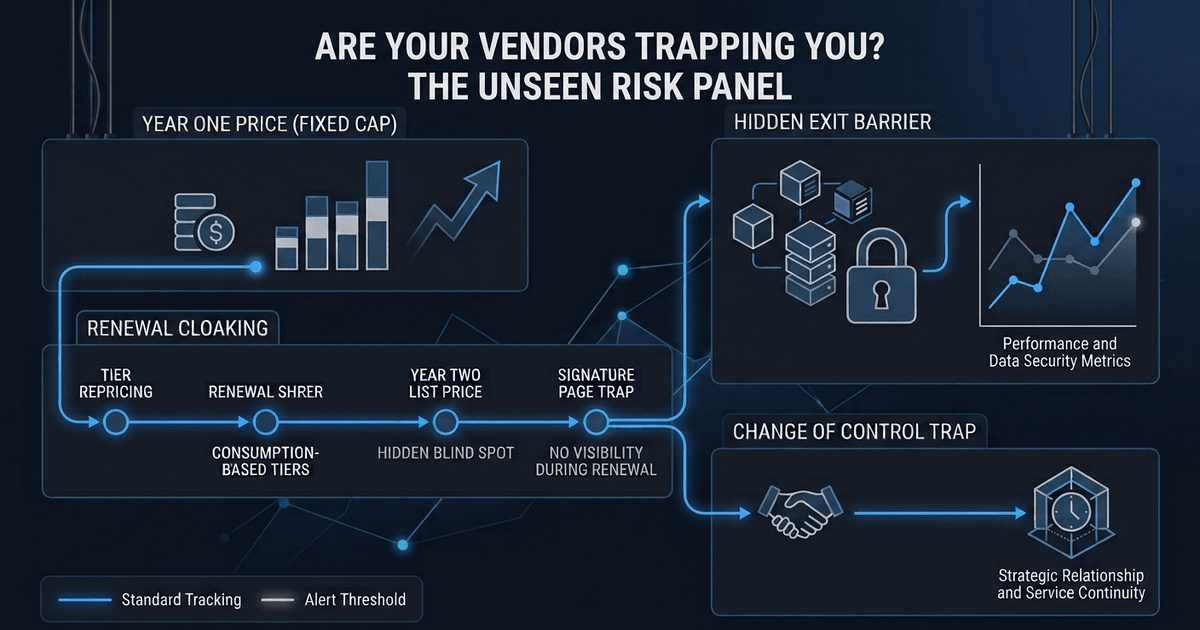
The price on the renewal quote was 4% higher than last year. Reasonable, everyone in the room agreed. Nobody reread the clause on page fourteen: the one that let the vendor reprice individual usage tiers mid-term, outside the 4% cap entirely. The 4% was real. It just wasn't the number that mattered.
The Auto-Renewal Trap
Most vendor contracts don't end. They roll forward, automatically, into another 12-month term unless someone actively stops them inside a specific window - typically 30 to 90 days before the term expires. Miss that window and the decision gets made for you, on the vendor's terms, at whatever price the contract already locked in.
This isn't an oversight in vendor contract design. It's the design. Gartner's guidance on cloud contract auto-renewal strategy exists because so many procurement teams get caught by it that Gartner built a formal decision framework - the "Z Path" - just to help sourcing leaders decide when an automatic renewal term is acceptable and when it needs a hard stop. Gartner's own recommendation is blunt: automatic renewal terms should never exceed one year, because every year beyond that is a year the vendor doesn't have to re-earn the business.
The financial pressure behind this is not hypothetical. Zylo's 2026 SaaS Management Index found that 78% of IT leaders reported unexpected charges tied to AI features or consumption-based pricing in the past year, and 61% were forced to cut other projects to absorb unplanned SaaS cost increases. An auto-renewal clause is the mechanism that turns "unexpected" into "already signed." The vendor doesn't need to convince you the new price is fair. They just need you to miss a 60-day window buried in a contract you signed 11 months earlier.
The fix is not complicated, which is what makes skipping it so expensive. A calendar reminder set 90 days before any contract's renewal date, tied to a person who actually owns the relationship, closes this gap entirely. The clause itself is negotiable too: Gartner notes that vendors will almost always shorten an auto-renewal term or extend the notice window when asked directly at signing, because the leverage is highest before the contract is executed and drops to nearly zero the moment it isn't.
Price-Lock Expiration: the Clause That Makes Year One a Loss Leader
A vendor quoting a fair year-one price is not necessarily quoting a fair contract. The number on the signature page describes one year. The price protection clause, or its absence, describes every year after that - and most negotiations spend all their energy on the first number and none on the mechanism that governs the rest.
Vertice's SaaS Inflation Index put the current rate of SaaS price increases at 13.2%, nearly five times the standard consumer inflation rate across G7 economies. That gap alone should change how technical leaders read a renewal quote. But the more useful finding in the same report is structural, not statistical: 60% of vendors deliberately obscure the size of their price increases, whether through bundling, tier restructuring, or introducing new AI-feature add-ons priced separately from the base subscription. A contract without an explicit price cap has no defense against any of that. It simply resets to whatever the vendor's pricing team decides list price should be that year.
A cheap year-one price protects the number on this quarter's budget slide. A negotiated price cap protects the number on next year's, and the year after that. Only one of those is actually a discount.
Gartner's research on renewal cost optimization identifies this as the single most commonly skipped negotiating point: technology contracts are frequently negotiated hard on the initial price and left almost entirely undefended on subsequent renewal terms. The fix Gartner recommends is a hard price-protection clause, capping annual increases at a fixed percentage, ideally in the 3-5% range, for the full life of the relationship, not just the first term. Without it, the vendor is free to treat the year-one discount as a loss leader and recover the margin later, when the switching cost is higher and the negotiating leverage has moved entirely to their side.
Data Portability and the Real Cost of Leaving
Exit cost is an engineering budget line, not a legal footnote, and most contracts never force anyone to quantify it before signature. The clause that matters here is narrow and specific: what format does your data come out in, who pays to move it, and does the vendor charge anything beyond standard infrastructure cost to let you leave.
AWS's own S3 pricing is a useful, uncomfortable baseline for what "just move the data" actually costs even under a well-behaved vendor with no punitive exit fees at all. Data transfer out to the internet is priced at $0.09 per GB after the first 100GB each month, which is free. That's not a lock-in penalty; it's the honest cost of egress from any cloud-hosted platform. A team migrating 50TB off a vendor pays roughly $4,500 in transfer fees alone, before a single engineering hour is spent mapping schemas, rebuilding integrations, or validating that the migrated data matches the source.
Flexera's 2026 State of the Cloud Report found that 73% of organizations now run hybrid cloud, and that multicloud adoption keeps rising largely unintentionally - driven by mergers, siloed application teams, and inherited architecture rather than a deliberate exit strategy. Read against the egress math above, that's not a story about technical sophistication. It's a story about companies discovering, after the fact, that leaving costs more than anyone budgeted for, and building around the vendor rather than out of it.
The clause worth negotiating is not "can we get our data out." Every vendor will say yes to that question, because it's true in the narrowest sense: an export button exists. The clause worth negotiating is whether that export lands in a standard, non-proprietary format, within a defined number of days, at no cost beyond the underlying cloud provider's own transfer pricing. A vendor that won't commit to that in writing is telling you, without saying it directly, that the export button is a formality, not a real exit path.
Change-of-Control Clauses: When Your Vendor Gets Acquired
This is the clause almost nobody reads until the acquiring company's sales team calls with a new number. A change-of-control provision governs what happens to your contract when the vendor itself is bought, merged, or restructured - and in a market where consolidation is the default exit for venture-backed software companies, that's not an edge case. It's a near-certainty over a multi-year contract term.
Nixon Peabody's review of M&A due diligence failures in software licensing describes a pattern that repeats across deals: anti-assignment and change-of-control provisions buried in commercial contracts are routinely overlooked during diligence, and surface only after close, forcing costly renegotiation under conditions the customer no longer controls. From the customer side, the same clause cuts the other way. If a vendor's change-of-control terms are silent on repricing, the acquiring company inherits full discretion to reset pricing, support tiers, or product roadmap the moment the deal closes - with no obligation to honor whatever was negotiated with the previous owner.
Forrester's guidance on vendor contract negotiation frames the underlying dynamic plainly: negotiating with tier-one vendors is an exercise in asymmetric power, where complex licensing, audit threats, and high switching costs are used deliberately to maximize revenue and lock customers in. A change-of-control event resets that asymmetry in the vendor's favor a second time, handing a new owner the same leverage the original vendor spent years building, without the new owner having earned any of the trust that made the original relationship tolerable.
A contract silent on change-of-control isn't neutral. It's a bet that your vendor never gets acquired - in a market where acquisition is the most common outcome for a venture-backed software company, not the exception.
The clause worth having in writing states two things: that the current pricing and service terms survive a change of control for the remainder of the contract term, and that the customer retains a defined right to exit without penalty if the new owner materially changes the product, support, or pricing structure within a set window after close. Neither term stops an acquisition from happening. Both terms stop the acquisition from becoming your problem to absorb on someone else's timeline.
The Four-Clause Audit
None of these four clauses require a lawyer to spot. They require someone to actually read past the pricing table before signature, which is precisely the step most procurement processes skip, because the pricing table is the part everyone already agrees to argue about.
WorldCC's Most Negotiated Terms report, drawn from nearly a thousand commercial and contract management practitioners globally, puts limitation of liability and price/change clauses at the top of what organizations spend negotiating time on - a pattern that's held for over a decade. Termination rights and exit options have been rising in that same ranking in recent years, which tracks with everything above: negotiators are starting to notice that the clauses governing what happens after signature matter as much as the number on the first page. They just haven't caught up to auto-renewal windows, price-lock duration, portability terms, and change-of-control provisions as a connected set.
Run this before signature, not after. Legal review typically checks whether a clause is enforceable. It rarely checks whether the combination of a short auto-renewal window, an unprotected price term, a proprietary export format, and a silent change-of-control clause adds up to a contract that's structurally built to extract more value than the number on the signature page implies. That combined read is the technical leader's job, not procurement's and not legal's, because only the person who understands what the system actually costs to rebuild elsewhere can put a real number on what each red flag is worth.
The four clauses in that audit aren't equally visible in a typical negotiation. Price gets argued because everyone in the room already knows it matters. Auto-renewal, price-lock duration, portability, and change-of-control get skipped because they don't show up as a number until the year they trigger - and by then, the leverage that could have fixed them at signature is gone.
A contract that's fair on page one and unreadable on page fourteen isn't a fair contract. It's a bet that no one will ever read page fourteen.
Sources
- Gartner - Devise an Effective Cloud Contract Autorenewal Clause Strategy Using the Z Path Decision Matrix - guidance limiting auto-renewal terms to no more than one year and formal decision framework for renewal strategy
- Gartner - Optimize Software and SaaS Renewal Costs by Using Protection Clauses - finding that well-negotiated contracts routinely lack price protection for subsequent renewal terms
- Gartner - Services Contracting Master Terms: Term, Termination, Renewal and Disentanglement - framework for termination, renewal, and disentanglement clause design
- Zylo - 2026 SaaS Management Index - 78% of IT leaders reported unexpected renewal-cycle charges; 61% cut projects due to unplanned SaaS cost increases
- Vertice - SaaS Inflation Index 2026 - SaaS price inflation at 13.2%, roughly 5x G7 consumer inflation; 60% of vendors deliberately obscure price increases
- Flexera - 2026 State of the Cloud Report - 73% of organizations run hybrid cloud; multicloud adoption often unintentional, driven by M&A and siloed teams rather than deliberate strategy
- AWS - Amazon S3 Pricing - data transfer OUT priced at $0.09/GB after the first 100GB/month free tier
- Forrester - A Guide For Optimizing Vendor Contract Negotiations - tier-one vendor negotiation as asymmetric power, using complex licensing and high switching costs to secure lock-in
- Nixon Peabody LLP - M&A Due Diligence: A Cautionary Tale in Software Licensing (2025) - anti-assignment and change-of-control provisions routinely overlooked in diligence, forcing costly post-close renegotiation
- World Commerce & Contracting - Most Negotiated Terms 2024 Report - survey of 937 respondent organizations; limitation of liability and price/change clauses top the list, with termination and exit rights rising in negotiator focus