RAG Fundamentals: A Map of Every Architecture
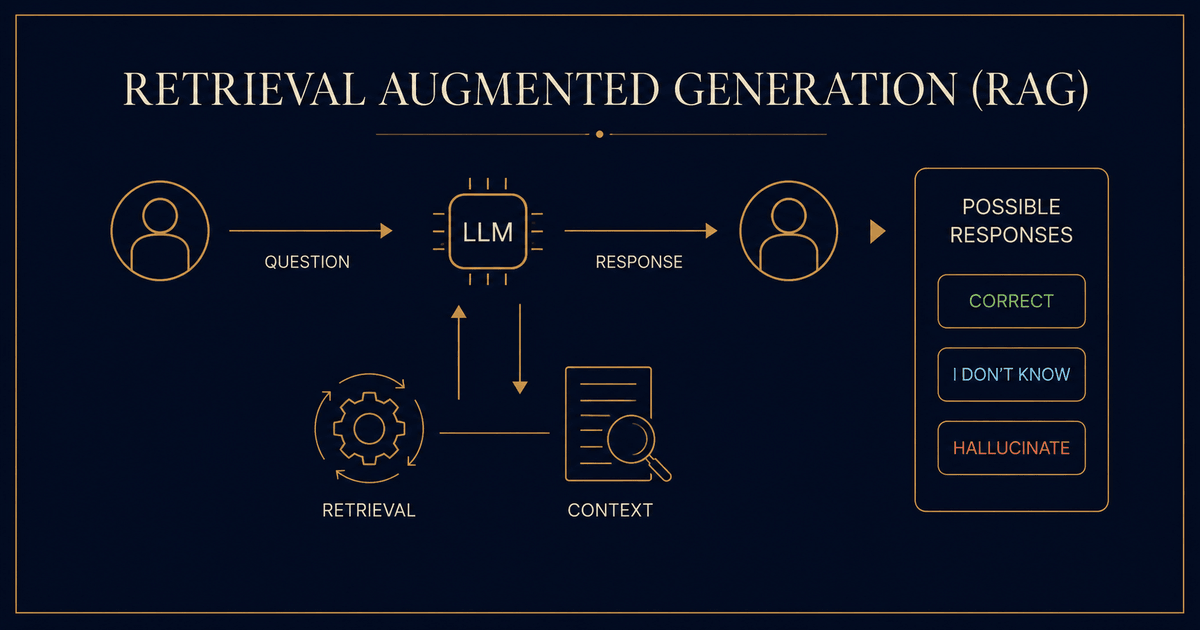
A linear, one-concept-per-lesson survey of retrieval-augmented generation: the baseline pipeline, the nine named architectures built on top of it, and a decision framework for choosing among them. 22 lessons · 3 tiers.
Prerequisites: No coding background required. Helpful, not required, to have used an LLM chat product and to know roughly what a search engine does.
This course has no code and no API key: every lesson works through mental models, diagrams-in-prose, and worked comparisons. It is a conceptual map of the RAG landscape, written for someone deciding which architecture fits a problem, not implementing one line by line. Lessons on specific techniques (vector indexing, chunking, hybrid search) go deep hands-on in this site's pgvector, docling, and llamaindex courses; this course is what to read before those, to know which technique you actually need.
Beginner
The pipeline, embeddings, and the three core architectures: naive, advanced, and modular RAG.
- 01What Is Retrieval-Augmented Generation, and Why Does It Exist?
- 02The RAG Pipeline: Indexing, Retrieval, and Generation
- 03Embeddings and Vector Similarity, Briefly
- 04Naive (Standard) RAG: The Baseline Architecture
- 05Where Naive RAG Breaks: Common Failure Modes
- 06Advanced RAG, Part 1: Pre-Retrieval Optimization
- 07Advanced RAG, Part 2: Post-Retrieval Optimization
- 08Modular RAG: Composable, Plug-and-Play Pipelines
- 09Checkpoint: Comparing Naive, Advanced, and Modular RAG
Intermediate
Specialized retrieval strategies: hybrid search, graph RAG, corrective RAG, and how to evaluate any of them.
- 10Why Specialize Retrieval Beyond Modular RAG
- 11Hybrid RAG: Combining Dense (Semantic) and Sparse (Keyword) Search
- 12Graph RAG: Knowledge Graphs and Multi-Hop Reasoning
- 13Graph RAG vs. Hybrid RAG: When Each One Wins
- 14Corrective RAG (CRAG): Self-Evaluation and Correction
- 15Evaluating RAG Systems: Metrics That Actually Matter
- 16Checkpoint: Diagnosing a Retrieval Failure and Choosing a Fix
Advanced
Agentic, multimodal, and adaptive RAG, closing with a decision framework and a capstone.
- 17Agentic RAG: Planning, Tool Use, and Iterative Retrieval
- 18Agentic RAG in Practice: Multi-Step Research Workflows
- 19Multimodal RAG: Retrieving Across Text, Images, Audio, and Video
- 20Adaptive RAG: Matching Retrieval Depth to Query Complexity
- 21Choosing a RAG Architecture: A Decision Framework
- 22Capstone: Mapping a Real System to a RAG Type