AI search referral traffic grew 796% in one year and converts at higher rates than organic search. The sites capturing that growth share one characteristic: their content is legible to machines, not just humans. This article documents the three-wave framework that gets you there - with every fix verified against a real production deployment.
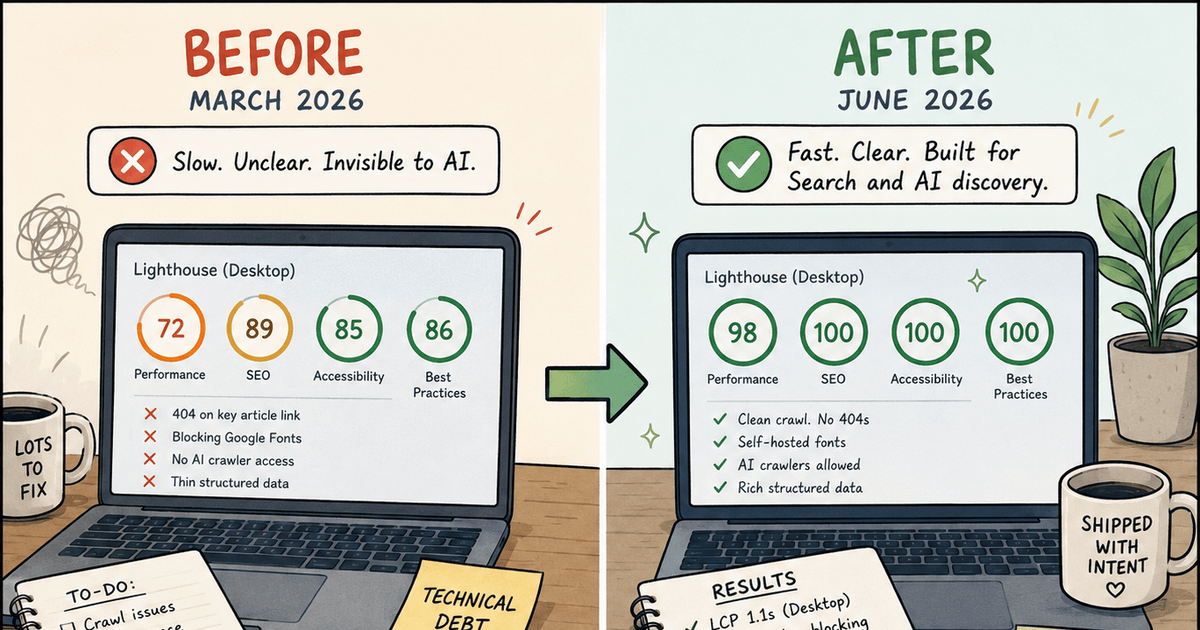
Worked example: All benchmarks, before/after figures, and code samples are drawn from a single production audit of andreinita.co - a static Astro 6 portfolio deployed on Netlify. The "before" scores reflect the March 2026 baseline; the "after" scores reflect June 2026 after three optimisation waves. The framework is transferable to any comparable static site; specific numbers will differ on yours. For Core Web Vitals performance optimisation (LCP, TBT, font loading) - which Google confirms as a ranking signal - see How to Hyper-Optimize Website Performance with PageSpeed Insights.
AI search referral traffic grew 796% between January 2024 and December 2025, per WebFX research tracking 150 million sessions across multiple industries. BrightEdge found that AI-referred visitors convert at measurably higher rates than organic search visitors: they arrive with a specific question already answered and are evaluating providers, not still searching. That channel is now large enough that being absent from it is a quantifiable revenue decision - every AI assistant query that does not surface your content sends a potential buyer to a competitor's answer instead.
Most sites are absent from it. Not because their content is poor. Because their site is not legible to the systems that decide what to cite.
The root cause is entity disambiguation. Google's ranking signals and large language model citation signals both reward the same underlying property - unambiguous, verifiable, machine-readable content identity. A site legible to Google's indexer is, by definition, legible to AI crawlers. Most SEO audits stop at crawlability. Most AIEO guides treat AI crawler permissions as a separate project. Both miss that the fixes are the same workstream - and that most sites have not started either.
What follows is a three-wave audit framework applied to a static portfolio site (andreinita.co), with every fix documented and every metric verified against real Lighthouse data and Search Console field results. The failure categories it surfaces are structural and appear in any comparable site. The fixes are copy-paste ready.
The Audit: Three Failure Categories to Find First
Before writing a single line of optimisation code, run a four-instrument audit. Each instrument exposes a different failure layer that the others miss.
- PageSpeed Insights - field data from real users via CrUX, plus Lighthouse lab data. Start here for a quick read on whether your Core Web Vitals are in the Good band.
- Screaming Frog (or any crawl tool) - crawls your site as a bot would and surfaces 404s, redirect chains, missing meta tags, and title/H1 mismatches that visual QA never catches.
- Chrome DevTools Network tab - shows the actual waterfall for your critical rendering path: which resources block paint, what your real page weight is per category.
- Lighthouse JSON export - the structured output behind the score. Export it, save it. It is your before-state baseline. Every subsequent audit compares against it.
After running all four, you will find your failures in one of three categories:
Crawl health - broken internal links consuming crawl budget, stale sitemap lastmod dates suppressing freshness signals, below-fold images loading eagerly on every page start.
Indexing signals - missing article:tag Open Graph meta, absent hreflang self-referential tags, title and H1 tags that have diverged on the same page.
Entity legibility - structured data that stops at token presence rather than disambiguation, and a robots.txt that says nothing about AI crawlers.
That last category is where most sites lose the AIEO layer entirely. WebFX (2025) tracked generative AI referral traffic growing 796% between January 2024 and December 2025. BrightEdge's research shows ChatGPT mentions brands three times more than it cites them - but the precondition for either is that the crawler was allowed in. A robots.txt that names only Googlebot may leave the five major AI agents unaddressed entirely.
Add explicit entries for each agent to your robots.txt:
# Allow AI scrapers for content citation and discoveryUser-agent: GPTBotAllow: /
User-agent: ChatGPT-UserAllow: /
User-agent: CCBotAllow: /
User-agent: anthropic-aiAllow: /
User-agent: Claude-WebAllow: /
Two additional instruments belong in your toolkit - not for the initial audit, but for verifying impact after you ship fixes:
Google Search Console - the URL Inspection tool confirms what Google has actually indexed; the Coverage report surfaces crawl errors; the Core Web Vitals report shows field data from real users, which lags Lighthouse lab data by approximately 28 days. Google Search Central documents Search Console setup at developers.google.com/search/docs/monitor-debug/search-console-start.
Google Analytics 4 - filter organic / google sessions to confirm that indexing changes translated to real traffic. Add a custom segment for AI referral sources (chatgpt.com, claude.ai, perplexity.ai) to begin measuring AIEO citation traffic separately from organic search.
Lighthouse and Screaming Frog find the problems. Search Console and GA4 confirm the fixes worked.
Wave 1: Three Crawl Health Fixes
Start here. These three fixes address the most expensive categories of crawl waste and require no build pipeline changes - no new dependencies, no CI configuration. They can all be shipped in under two hours.
Each failure costs you indexing priority - the crawl budget search engines allocate to your domain. A site wasting crawl credits on 404s and stale freshness signals gets crawled less frequently. New content takes longer to surface in search results. The gap between your site and a competitor who fixed these issues compounds week over week, invisibly, until it shows up as an organic traffic differential you cannot easily explain.
Fix 1: Audit every internal link your homepage serves to crawlers. Your homepage is typically the highest-crawl-priority URL on your site. Any internal link it serves to a 404 is a crawl credit spent on failure. Run your homepage URL through Screaming Frog or Google Search Console's URL Inspection, then trace every outbound link. Fix broken targets with a 301 redirect or update the source link directly. For example, andreinita.co's homepage linked to /blog/ai_strategy_roi_article/ - a slug that had been renamed. Every Googlebot crawl was hitting a 404 before reaching the content it came for. One line in _redirects eliminated it.
Fix 2: Add loading="lazy" to every below-fold image. Images that are not in the initial viewport but load eagerly consume bandwidth reserved for your Largest Contentful Paint element. Add loading="lazy" decoding="async" to every image that is not a LCP candidate. On a typical portfolio homepage, this applies to company logos, social proof images, and any section below the fold on a 768px viewport.
Fix 3: Correct stale sitemap lastmod dates. Google Search Central's documentation is explicit: the lastmod value is trusted only when it is consistently and verifiably accurate relative to actual page modifications. If your sitemap shows a 2023 date for a page last updated in 2025, Google stops weighting those freshness signals for your domain. Audit your sitemap and correct every lastmod to reflect the actual last-published or last-modified date for that URL.
Crawl budget is finite. Every 404 your homepage serves to Googlebot is a crawl credit spent on failure, not discovery. These three fixes reclaim that budget without touching the application layer.
Wave 2: Three Indexing Signals Most Developers Skip
These three signals are invisible in normal browser testing. No visual change, no performance metric shifts when they are missing. But they carry a direct business consequence that is easy to underestimate: they do not just determine where you rank within a query - they determine which queries surface your pages at all. A title/H1 mismatch creates genuine ambiguity about what your page covers. That ambiguity is resolved in favour of competitors who wrote both consistently. A missing hreflang tag means your geographic targeting is undefined, which affects which market your content surfaces in. These are classification problems, not ranking problems - and they sit above ranking in the search funnel.
Signal 1: Add article:tag Open Graph meta to every blog post. Without per-post article:tag elements, your posts have a type (og:type = article) but no subject. Adding individual tags gives the Open Graph parser faceted metadata for categorisation - not just a title and description, but structured signals about what each article actually covers. In Astro, this is a single map over your tags array:
{isBlogPost && tags && tags.map((tag: string) => ( <meta property="article:tag" content={tag} />))}Signal 2: Add self-referential hreflang tags. Google Search Central's localisation documentation requires that every page in a hreflang set include a tag pointing back to itself. A single-language site targeting a specific market - say, en-GB - still needs the self-reference plus an x-default fallback. Omitting the self-reference causes search engines to misinterpret which URL is canonical for that language-region combination. The fix is two lines:
<link rel="alternate" hreflang="en-GB" href={canonicalUrl} /><link rel="alternate" hreflang="x-default" href={canonicalUrl} />Signal 3: Verify H1 and title tag match on every page. Your <title> tag is the primary string Google uses to represent your page in search results. When your H1 says something different, the indexer has to arbitrate between two competing signals about what the page covers. Run a Screaming Frog crawl filtered on "Page Titles" vs "H1" - any row where the two columns diverge needs fixing. Andreinita.co had one article where these had diverged during an edit cycle. One line corrected it.
The indexer does not infer your intent from prose. It reads the meta layer you either wrote or did not.
Wave 3: Structured Data Depth and Entity Disambiguation
Most sites that implement structured data stop at token presence: a Person type with a name and a URL. That passes schema validators. It does not achieve entity disambiguation - and disambiguation is what separates a structured data implementation that helps the indexer from one that also helps the language model.
The distinction matters because both systems need to resolve the same question: is this entity specific enough to be cited with confidence? Princeton's GEO paper (Aggarwal et al., 2023) studied 10,000 queries across generative engines and found that adding authoritative statistics, citing credible sources, and providing fluent entity-rich content increased AI citation rates by up to 40%. The mechanism applies directly to your JSON-LD: an unambiguous entity with verifiable attributes is a node a language model can attach to and return in response to a query.
Entity disambiguation is also a competitive moat, because AI citation compounds. A language model that has successfully resolved your entity - matched your expertise to named organisations, cross-referenced your profiles, verified your claims against sameAs entries - will cite you again. An entity it cannot resolve will be replaced by one it can. Competitors investing in structured data depth now are building a citation track record that becomes harder to displace as AI search matures. The sites consistently appearing in AI-generated answers for your category did not get there by accident.
The standard to aim for in a Person schema: knowsAbout as an array of DefinedTerm objects with description fields (not just strings), alumniOf as named organisations with URLs, sameAs as verified profile URLs, and hasOccupation with a geographic occupationLocation. For every blog post, add a BlogPosting schema with mainEntityOfPage - its absence generates silent validation warnings in Search Console's Rich Results report. Below is a reference implementation from andreinita.co that you can adapt to your own entity:
{ "@context": "https://schema.org", "@type": "BlogPosting", "headline": "Article title here", "datePublished": "2026-06-01T00:00:00Z", "dateModified": "2026-06-01T00:00:00Z", "author": { "@type": "Person", "name": "Your Name", "url": "https://yoursite.co" }, "url": "https://yoursite.co/blog/slug/", "mainEntityOfPage": { "@type": "WebPage", "@id": "https://yoursite.co/blog/slug/" }, "articleBody": "Full article text here. An LLM extracting content from JSON-LD does not need to parse HTML, survive minification, or handle JavaScript rendering gaps."}The articleBody field is a citation pathway, not a convenience. A language model extracting content from JSON-LD bypasses HTML parsing entirely - no rendering pipeline, no minification artifact, no hydration gap. Google Search Central's structured data guidelines confirm that this field is processed by Google's systems when present.
The knowsAbout DefinedTerms serve the same disambiguation function for the entity itself. "CTO Consultant" is a string. "CTO Consultant: fractional CTO leadership for B2B SaaS startups at Series A through Series D, specializing in cloud cost reduction, data platform architecture, and engineering delivery" is a node with a verifiable description that a language model can resolve and return with confidence.
Ask this about your own site before moving on: can a machine unambiguously identify who you are and what you know from your metadata alone, without reading a single sentence of prose? If the answer is no, the citation layer does not know you exist - regardless of how well your content ranks.
Measuring What Changed: Search Console, GA4, and the AI Referral Layer
Shipping three waves of fixes without measuring them is engineering without feedback. After deploying each wave, return to Search Console and GA4 to verify the changes registered in the real world - not just in Lighthouse lab simulation.
Search Console - Core Web Vitals report. Field data from real users lags Lighthouse lab data by approximately 28 days. Check the CWV report four weeks after shipping to confirm that improvements registered in the field. Lab data and field data diverge on slow devices and variable network conditions - field data is what Google actually uses for ranking.
Search Console - URL Inspection. Run each optimised URL through URL Inspection to confirm it is indexed, that structured data is parsed without errors, and that canonical tags are resolving correctly. The Rich Results section of the report will show whether your BlogPosting schema qualifies for any rich snippet treatment.
GA4 - organic session uplift. Filter the Traffic Acquisition report for organic / google sessions. Indexing signal improvements (Wave 2) typically show a 2 to 6 week lag before organic session uplift is visible. Structured data improvements may not show as direct traffic gains - their effect is citation quality and rich result eligibility, not necessarily raw session count.
GA4 - AI referral segment. Create a custom segment filtering sessions where session_source contains chatgpt.com, claude.ai, or perplexity.ai. This isolates citation-driven traffic from AI assistants so you can measure the AIEO layer independently of organic search. AI referral traffic currently converts at a higher rate than organic search traffic, per BrightEdge's 2025 data, because visitors arrive with a specific question already answered - they are evaluating, not searching.
The Two-Instrument Framework: What Lighthouse Measures and What It Does Not
Lighthouse is a local optimum. It measures page load performance, markup quality, and accessibility compliance. A perfect Lighthouse score confirms that your site is technically well-built. It says nothing about whether a language model can identify the entity behind your site as a credible, citable source when someone asks a question you are specifically qualified to answer.
Those are different instruments measuring different things. Treating them as the same optimisation problem is how sites end up with Lighthouse 100 and zero AI citation presence - technically correct, but invisible to the fastest-growing discovery channel in professional services.
The three-wave framework documents what it looks like to optimise the discoverability layer - signals, schemas, and entity clarity - simultaneously for Google and AI. The andreinita.co benchmark after all three waves: 98/100/100/100 desktop, 80/100/100/100 mobile. BrightEdge's 2025 research documents AI search referral visits surging year-over-year. WebFX found AI platform referral traffic grew 796% between 2024 and 2025. The structured data work in Wave 3, the AI crawler allowlist in the audit, and the entity-rich knowsAbout DefinedTerms in the Person schema are not Lighthouse optimisations. They are infrastructure for a citation layer that compounds over every crawl cycle you have explicitly permitted.
The business consequence is direct. Organic search captures buyers who are searching. AI search captures buyers who have already decided what they need and are evaluating providers. Being absent from organic search is a ranking problem - fixable with the right content and technical signals. Being absent from AI search is an opportunity problem at a different point in the funnel, and a harder one to diagnose because it produces no error, no dropped ranking, no alert. It just produces silence at precisely the moment a high-intent buyer was asking for someone exactly like you.
Lighthouse tells you how fast your site loads. It says nothing about whether a language model identifies you as a credible, citable entity when someone asks for a fractional CTO in London. Those are different instruments measuring different things. You need both at 100.
Sources
- Aggarwal, P. et al. "GEO: Generative Engine Optimization." Princeton University, 2023. arxiv.org/abs/2311.09735
- HTTP Archive Web Almanac 2024, SEO chapter. almanac.httparchive.org/en/2024/seo
- Google Search Central. "Build and Submit a Sitemap." developers.google.com/search/docs/crawling-indexing/sitemaps/build-sitemap
- Google Search Central. "Localized Versions of Your Pages (hreflang)." developers.google.com/search/docs/specialty/international/localized-versions
- Google Search Central. "Understanding Core Web Vitals and Google Search Results." developers.google.com/search/docs/appearance/core-web-vitals
- Google Search Central. "How to Use Search Console." developers.google.com/search/docs/monitor-debug/search-console-start
- Google Search Central. "Intro to Structured Data Markup." developers.google.com/search/docs/appearance/structured-data/intro-structured-data
- BrightEdge. "AI Search Visits Surging in 2025." brightedge.com/resources/research-reports/ai-search-visits-in-surging-2025
- WebFX. "Study: AI Traffic Grew 796% and Out-Converts Organic Search, 2025." webfx.com/blog/seo/gen-ai-search-trends/