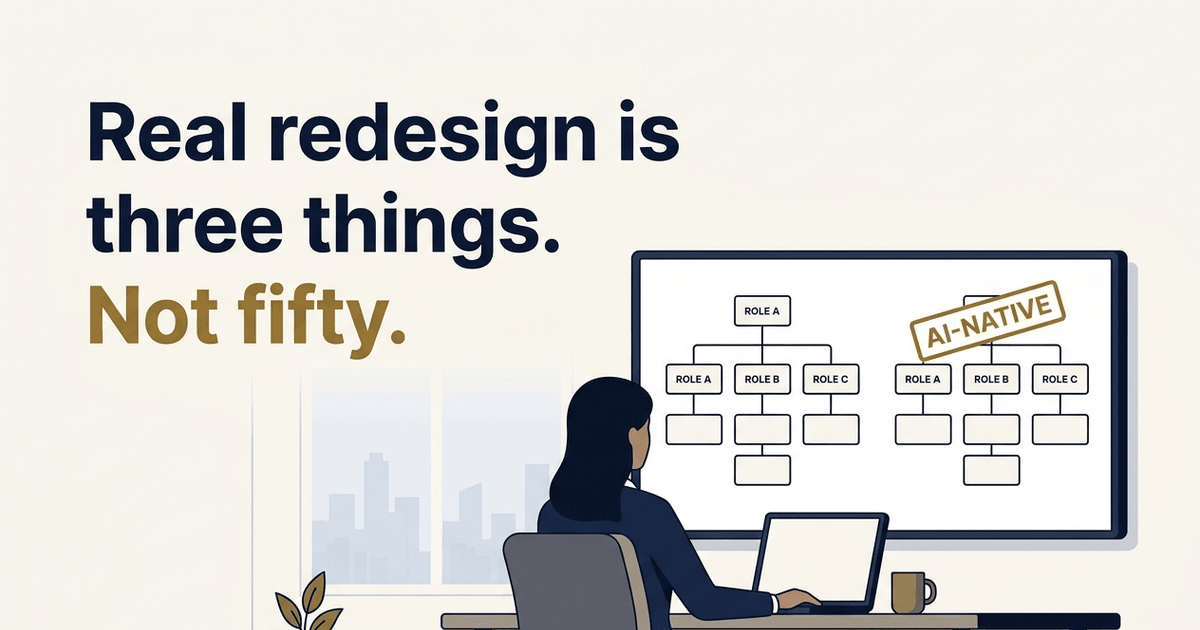
Deloitte spent three billion dollars and touched 181,500 US employees rewriting what to call them. Analyst becomes an alphanumeric level. Manager becomes something else. A new "Leaders" class joins the partners. In the same announcement, the firm told those employees the day-to-day work, the leadership, and the compensation philosophy would all stay the same.
That sentence is the whole problem with "AI-native" as a category. A company can spend nine figures and touch six figures of headcount on an org redesign that, by its own description, changes nothing about who does what.
The Announcement That Says the Quiet Part
This isn't a story about Deloitte being dishonest. It's a story about a category that has no test. Deloitte's restructuring, effective mid-2026, replaces the analyst-to-consultant-to-manager ladder with role-specific titles like "Software Engineer III" and alphanumeric internal levels, alongside a $3 billion commitment to generative AI development through 2030 (Fortune, 2026). The firm's own framing was that it is "modernizing our talent architecture to provide a more tailored experience," which is the kind of sentence that means something happened without committing to what.
Gartner's research suggests Deloitte is not an outlier in this. A May 2026 survey of senior supply chain leaders found that 83% of organizations pursuing AI are applying it incrementally to specific use cases or gradually scaling it into existing processes, not pursuing immediate transformational redesign (Gartner, 2026). Only 17% are doing the harder thing. The claim and the change are running at different speeds almost everywhere, not just at one consulting firm with a title problem.
None of this means AI-native redesign is fake. McKinsey's 2026 research on operating-model change is explicit that real versions exist: shared services rebuilt as AI-native centers, roles remapped for human-agent allocation, and organizations investing five dollars in people for every dollar spent on the technology itself (McKinsey, 2026). The real version is out there. It's just outnumbered by the version that only changed the org chart's font.
If a company can't tell you which approval a person used to give that a system gives now, "AI-native" is a slide, not a structure.
Rebrand vs. Redesign: The Test That Actually Works
Here's the diagnostic, stated plainly: a real AI-native redesign changes three specific things, and only three. It changes who reviews what. It changes how many people one manager can actually run. And it changes which decisions still need a human sign-off before they happen. Everything else, the new titles, the AI-first strategy deck, the Chief AI Officer appointment, is packaging around those three changes or, more often, packaging with nothing inside it.
The diagram below shows what the first of those three looks like in practice, comparing a traditional review chain to the version one frontier AI lab's own engineering team reports running.
The traditional chain has a peer reviewing style and logic, then a manager signing off on scope and priority, before anything ships. The redesigned version splits that same work differently: an agent takes the mechanical review, and the human step narrows to the judgment a system genuinely cannot make. That narrowing is the tell. It's specific, it's falsifiable, and a company can show it to you in an afternoon by pulling up an actual pull request. A renamed title cannot be shown to you in the same way, because there's nothing under it to point at.
Real Change One: Who Reviews What
Anthropic's own account of running its Claude Code engineering team draws this boundary in writing, not in the abstract. "Claude handles all the style and linting, PR feedback requests, catching bugs and fixing them before a full commit, and adding tests," while human review stays narrow and specific: "for legal review, I always want my legal partner involved in risk tolerance. For trust boundaries and security-sensitive code, I want the domain experts" (Anthropic, 2026). The team adds a checkable detail rather than a vague one: "by default, every commit is Claude-assisted. I don't think I've seen a non-Claude-assisted commit in the last four months," a claim about one team's specific practice, not a universal ratio, and one a reader could ask to see disproven.
That's the shape of a real change: a company naming, in writing, which categories a human still owns and which a system owns now. It doesn't require every AI-native claim to match this exact split. It requires every AI-native claim to have a split at all, stated this specifically, not asserted as a vibe.
MIT's Project NANDA studied more than 300 disclosed AI initiatives and found that 95% of generative AI pilots fail to reach production, not that they fail outright (MIT NANDA, 2025). The report's own authors attribute the gap primarily to a technical limit, systems that don't retain context or adapt over time, not to organizational design specifically. Worth stating plainly, since it would be easy to overreach here: this section's argument and MIT's finding point in a related direction without one proving the other. What they share is a structural observation, not a shared cause: a pilot with no named review boundary and a model with no persistent memory both stall at the same kind of handoff, the point where a human was supposed to decide what happens next.
Real Change Two: How Wide a Manager's Span Gets
The second real change is structural in the most literal sense: it shows up on the org chart as fewer boxes. Traditional engineering-management sizing puts a hands-on "player-coach" manager at 3 to 5 direct reports, a coaching-focused manager at 6 to 7, and a pure supervisor role at 8 to 10, per an analysis of manager span of control in the age of AI (Farrier, 2026). OpenAI's teams reportedly run closer to a 1:30 manager-to-engineer ratio, 1:40 inside the Codex group specifically, with 2-4 person project teams owning work end to end (Eng Leadership Newsletter, 2026).
That gap, roughly three to four times the traditional ceiling, is not achievable by working managers harder. It's only achievable if the manager's job changed what it consists of: less status-checking, less unblocking work a system now unblocks itself, more judgment calls concentrated at the top of a flatter structure. BCG documents a similar shift at Snowflake, describing a deliberate move toward "reducing transactional work" while "expanding spans of control" across the go-to-market organization (BCG, 2026). Gallup's own market-wide data shows the baseline moving too, average direct reports per manager rising from 10.9 to 12.1 between 2024 and 2025 (Gallup, 2026), though that's a fraction of what the OpenAI-reported ratio implies.
A manager who still has 6 direct reports and calls the team AI-native has changed the tooling. A manager who now has 25 and still ships has changed the org.
Real Change Three: Where Decision Rights Moved
The third change is the one boards actually ask about, because it's the one with a dollar figure attached: how many approval gates disappeared, and how much faster does a decision move without them. BCG's research describes one digital platform business that removed four full layers of management by restructuring around cross-functional teams enabled by AI agents, part of a broader pattern the firm found cutting decision cycles by up to 70% (BCG, 2026).
Seventy percent is a big number, and it should be treated skeptically without a named baseline, which BCG's public writeup doesn't fully provide for every case cited. But the direction is the right one to test for: a decision right only moved if someone who used to need a sign-off no longer needs it, and can name the specific approval that disappeared. Gartner's finding that 80% of CEOs expect AI to force operational overhauls (Gartner, 2026) tells you intent is nearly universal. It tells you nothing about whether a single sign-off gate has actually been removed at any of those companies yet. That's the gap this whole diagnostic exists to catch.
The Fifty Things That Aren't Real Changes
Everything outside those three changes is title work, and title work has its own research literature, most of it unflattering. Organizations with 500 or more employees commonly carry 400 to 800 distinct job titles that, once normalized against actual scope, would fit into 50 to 150 real role definitions (CareerBird, 2026). "Principal Agentic Context Engineer" is a real title in that research, paying more than "AI Engineer" purely because no HR system has a benchmark for it yet, not because the scope is different.
The World Economic Forum found that more than 10% of professionals hired today hold job titles that did not exist in the year 2000 (WEF, 2025). Some of that is real: new work genuinely needs new names. But a title is evidence of nothing on its own. The question was never whether the title is new. It's whether the approval behind it moved. A Chief AI Officer appointment, an "AI-first" line in a strategy deck, a rebranded team name: none of these are disqualifying, and none of them are proof either way. They're packaging. Check what's inside separately.
Run the Test on Your Own Org
The test travels, and it travels because it asks for something specific rather than something aspirational. For a CTO or VP Eng auditing their own org: pull one recent pull request and name, out loud, which review step a human still owns and which a system owns now, per the model above. Pull the manager headcount and the IC headcount and divide them, per the span-of-control data. Ask one director to name the last approval gate that was removed, not automated, removed, with a date. If any of those three questions gets a shrug, the org has a title, not a redesign yet, and that's worth knowing before the board deck says otherwise.
For a founder or board member evaluating a reorg pitch, or a technical executive doing vendor diligence, the same three questions work without modification, which is itself informative: a structural change that's real describes itself the same way to an engineer, a board member, and an outside evaluator, because it's a fact about the org, not a framing choice.
The honest limit of this framework is worth naming rather than hiding. It works best against an org with an existing structure to compare against: a review chain that had a shape before, a management layer that had a headcount before. A pre-revenue startup building its first ten hires has no "before" to diagnose against, and applying this test to a six-person team produces a false negative. Of course there's no removed approval gate; there was never a five-layer approval chain to remove one from. The test diagnoses change. It says nothing useful about a company that started AI-native because it started after the question existed.
Real redesign is a three-item list: who reviews, how wide the span, which sign-offs are gone. Any organization describing more than that, more roles, more values, more culture language, is very likely describing the packaging, and the org chart underneath it probably still says what it said a year ago.
Sources
- Fortune - Deloitte to Scrap Traditional Job Titles as AI Ushers In a "Modernization" of the Big Four (2026) - the $3B GenAI commitment, 181,500-employee scope, and the "day-to-day work will remain the same" framing.
- Gartner - Gartner Survey Shows AI Is Not Driving Supply Chain Operating Model Transformation (2026) - the 83% incremental / 17% transformational-redesign split.
- McKinsey - The Seven Operating Truths of AI-Native Companies (2026) - the $5-per-$1 people-to-technology investment ratio and role-remapping guidance.
- Claude by Anthropic - Running an AI-Native Engineering Org (2026) - the review-authority split and the "every commit Claude-assisted" claim, direct from the team running it.
- MIT Project NANDA - The GenAI Divide: State of AI in Business 2025 (2025) - the 95%-fail-to-reach-production finding and its stated technical cause.
- BCG - To Thrive in the AI Era, Tech Leaders Must Reinvent Organization and Operating Models (2026) - the four-management-layer removal case and the Snowflake span-of-control example.
- John Farrier - Engineering Manager Span of Control in the Age of AI (2026) - traditional player-coach/coach/supervisor span-of-control tiers.
- Eng Leadership Newsletter - How Companies Build AI-Native Engineering Teams (2026) - the reported OpenAI manager-to-engineer ratio.
- Gallup - Span of Control: What's the Optimal Team Size for Managers? (2026) - the market-wide 10.9-to-12.1 direct-reports increase, 2024 to 2025.
- Gartner - Gartner Survey Reveals 80% of CEOs Say AI Will Force Operational Capability Overhauls (2026) - intent data contrasted against actual redesign rates.
- CareerBird - Job Title Chaos: How to Fix Inconsistent Roles and Leveling Across Your Organization (2026) - the 400-800 titles normalizing to 50-150 roles finding.
- World Economic Forum - 2025: The Year Companies Prepare to Disrupt How Work Gets Done (2025) - the 10%-of-hires-hold-new-titles data point.