Most articles on this topic draw the line at 30-50 engineers. That threshold is real but it's a lag indicator. The actual trigger is a specific conflict - and most companies miss it until after it breaks something.
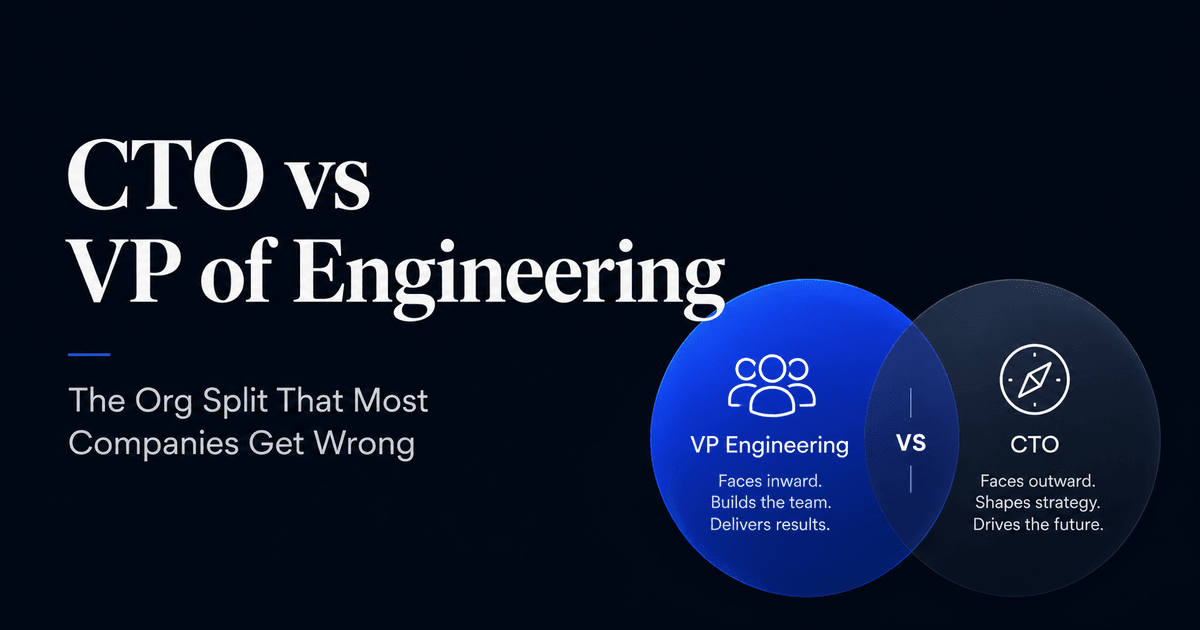
A CTO and a VP of Engineering are not seniority levels on the same track - they are different roles pointing in different directions. The CTO faces outward (strategy, board, investors, customers). The VP of Engineering faces inward (delivery, team health, hiring, process). Companies that treat the split as a seniority question create the wrong structure and the wrong hire.
The week it breaks
Tuesday, late 2023. Board deck due Friday. The platform team hit a critical blocker - a satellite imagery API we depended on had deprecated a key endpoint without adequate notice, breaking three months of pipeline integration work. Q1 delivery commitments were at risk.
I had two choices: stay in the technical incident with the team, or get back to altitude and finish the investor materials.
Both mattered. The delivery failure would affect commitments to customers. The board deck was the basis for a fundraising conversation that couldn't slip. I was the only person in the company who could do either well.
I did both badly. The deck went out Thursday at 11 PM. The platform incident took six days instead of three. Two engineers worked through a weekend they shouldn't have needed to.
That week - not any headcount milestone, not any funding threshold - is the clearest signal I know that a company has grown past what one technical leader can cover. Not because a single person isn't talented enough. Because strategy and delivery are genuinely competing for full attention, and when both have real stakes, neither gets what it deserves.
The yin-yang most companies get backwards
Fred Wilson wrote the clearest version of this in 2010: "The CTO makes sure the technical approach is correct. The VPE makes sure the team is correct and delivers quality products."
Most companies read this as a seniority ladder. The CTO is the more senior technical executive; the VP Engineering handles the delivery side and the people management. The CTO sets direction; the VP makes it happen.
That framing produces two failure modes. It produces a CTO who is technically strong, operationally consumed, and increasingly invisible to the investors and customers they're supposed to be engaging. And it produces a VP Eng who has a title but no real authority, because the CTO is still making delivery decisions.
The actual split is simpler: the CTO faces outward, the VP Engineering faces inward.
The CTO's most important relationships are with the CEO, the board, investors, customers, and the product leadership team. The VP Eng's most important relationships are with engineering managers, individual contributors, QA, design, and product. These are not better and worse versions of the same job. They are different jobs.
What each role actually owns
The responsibility matrices in most articles describe tasks. What they miss is the third column: what breaks when the responsibility isn't cleanly owned.
| Responsibility | CTO | VP Engineering | What breaks if unowned |
|---|---|---|---|
| Technology strategy | Owns | Provides input | Engineering builds excellently toward the wrong destination |
| External representation | Owns | Rare | Investors and customers lose confidence in technical credibility |
| Architecture decisions | Owns | Executes within | Technical debt accumulates in the wrong dimensions |
| Innovation & R&D | Owns | Rarely involved | Company falls 18 months behind on emerging technology |
| Delivery execution | Provides input | Owns | Roadmap commitments become suggestions |
| Hiring pipeline | Advisory | Owns | Hiring falls behind growth needs; team composition drifts |
| Org health & morale | Aware | Owns | Retention problems go unaddressed until someone leaves |
| Engineering metrics | Reviews | Owns | Delivery health is unmeasured or measured wrong |
| Process architecture | Sets standards | Executes | Teams operate differently; coordination overhead rises |
The most important column is the last one. When both roles are held by one person, one of the two columns gets sacrificed. In practice it's almost always strategy and external representation - because delivery has visible consequences and strategy doesn't. The late board deck is a bad day. The undefined architecture roadmap costs you 18 months of compounding technical decisions before it shows up anywhere measurable.
The real trigger - not 50 engineers
The conventional wisdom: split the roles at 30-50 engineers. The threshold is real, but it's a lag indicator.
Index Ventures, in their Scaling Through Chaos research on 100+ VC-backed companies, puts the co-founding CTO to outside engineering leader transition significantly later than the articles suggest. The shift most often happens at 251-500 employees - not 50. Many companies run a CTO-does-both model far longer than the conventional wisdom implies, and the ones that work are not unicorns. They're companies where the CTO was honest about what they were sacrificing, and could absorb the cost at that stage.
The more useful diagnostic isn't a number. It's four questions:
- Have you skipped board preparation in the last 90 days because a technical incident or delivery pressure took over?
- Have you missed an investor or customer conversation to handle an internal engineering problem?
- Has it been 30+ days since a meaningful 1-1 with a senior engineer that wasn't about an active incident?
- Is your technology roadmap out of date because you haven't had time to update it?
Two or more yes answers means you're past the threshold. The headcount rule is a proxy. The questions are the thing.
The chart above explains why "CTO" is not a standardized title. A CTO at 15 engineers is doing a fundamentally different job than a CTO at 500. The same responsibilities exist in both - they're just allocated in inverse proportion.
Three ways the split goes wrong
Getting this structure right is harder than getting the hire right. The patterns are consistent.
Anti-pattern 1: The CTO-as-VP-Eng trap
A technically excellent CTO joins a 40-person company. Delivery is fragile - the team is good but young, and the CTO's instinct is to stay close. Every time something is on fire (which is frequently at this stage), they dive in.
Three years later: delivery is strong. The engineering team executes well. The CTO is in sprint reviews every two weeks and knows every active ticket.
The problem: the CTO hasn't had a substantive conversation with an investor about technology strategy in six months. The architecture roadmap hasn't been updated in a year. When the board asks about the company's AI strategy, the answer is a vague commitment to "evaluate options."
Competitors have been making architecture bets - on new data infrastructure, on ML pipelines, on platform strategies. The company's stack is three decisions behind because no one was doing the work of looking ahead.
This is not a failure of the CTO's intelligence or dedication. It is a failure of the company to protect what the CTO was hired for. The CEO let it happen. The board didn't ask the right questions. The structure created the trap.
Anti-pattern 2: The VP-as-subordinate trap
Company recognizes the delivery problem and hires a VP Eng. But the CTO can't let go. Every sprint prioritization still needs their sign-off. Every hiring decision involves them. Every process change requires CTO approval.
Six months in, the VP Eng is a senior engineering manager with a better title and a larger salary. They have no real authority over process, headcount, or team structure. Their initiatives require CTO escalation. They can see what needs to change but can't change it.
The VP Eng leaves. The company now has a reputation - at least in the networks where VP Eng candidates talk - for not empowering the role. The next search is harder.
I've seen this pattern play out more often than the first. The hiring intent was right. The structural follow-through wasn't. The CTO wanted relief from delivery but not enough to actually give the ownership away.
Anti-pattern 3: The premature split
A 12-engineer company decides to structure correctly from the start. They hire both CTO and VP Eng. Every architecture decision needs alignment between two executives. Every hiring decision involves two approval chains. Two leadership meetings where one used to suffice.
The company moves slower, not faster. The coordination overhead rises faster than engineering output. This is most common when a founder hires from a company that had both roles at scale - and transplants the org chart without the org to support it.
At 12 engineers, one strong technical leader with delivery instincts is better than the right structure on paper.
Making the split work
When the split is the right call, three things determine whether it holds.
Write the ownership document before you hire. Not a job description - those describe tasks. An ownership document lists what the CTO is going to stop doing, and what the VP Eng will own from day one. If "sprint prioritization" doesn't explicitly transfer, the CTO will still be in sprint reviews at month six. If "headcount decisions" doesn't transfer, every hire requires two approvals. Define what moves before the person starts, and share it with both of them.
Give the VP Eng the hiring pipeline immediately. The clearest signal of real authority is owning who joins the team. If the new VP Eng can't make or block their first hire within 30 days, they don't have the role - they have the title. The hiring pipeline is also how they build the team they need to deliver what they've been asked to deliver. Delaying it delays everything.
The CTO has to actively give up delivery oversight. The transition from "I review every significant technical decision" to "I set the standards and trust the system" doesn't happen on its own. It requires deliberately removing yourself from sprint reviews, stopping ticket-level review, and investing the recovered time in strategy and external work. Most CTOs don't want to do this - they built their credibility on delivery depth. The transition requires treating that instinct as the thing to manage.
The founder's decision tree
Every article on this topic describes the roles. What founders actually need is a decision tool. Here are the four live scenarios.
| Stage | Eng team size | Typical structure | What changes |
|---|---|---|---|
| Pre-seed / Seed | 1–15 | CTO only | CTO handles strategy, architecture, delivery, and sometimes still codes |
| Series A | 15–40 | Split begins | Delivery becomes too large for one person to own alongside strategy - this is when to hire VP Eng |
| Series B–C | 50–150 | Both roles, clearly defined | CTO is external-facing; VP Eng runs the org. Reporting structure (CTO or CEO) becomes a real decision |
| Series D+ / Enterprise | 150+ | Both roles + Directors, Chief Architect | CTO is largely strategic and external; VP Eng manages a leadership layer beneath them |
"I have no one yet - which do I hire first?"
If your technical co-founder or founding engineer can set architecture direction and knows what you should be building: hire an engineering manager or head of engineering who owns delivery. The strategy is covered; the execution isn't.
If your founding team needs help with architecture decisions and you're heading into fundraising: hire a CTO first. Investors expect a credible technical leader to present the architecture direction. A CTO who can also manage delivery buys you 12-18 months before the split becomes necessary.
"My CTO is doing both - when do I add a VP Eng?"
Use the four questions from the previous section. If two or more are yes, you're past the threshold. The search typically takes three months - start before you think you need to. According to First Round Capital research on VP Eng hires, the right person should give you 18-24 months before the company outgrows them. Plan for 24.
"How do I tell CTO from VP Eng in an interview?"
For CTO candidates: ask what technology bets they'd make right now, and what past bets proved wrong. The quality of answer - specificity, honesty about failures, connection to business outcomes - tells you more than any architecture case study.
For VP Eng candidates: ask about a delivery breakdown they owned. Not how they identified it - how they fixed the system so it wouldn't happen again. You're looking for evidence of process architecture and metric changes, not incident response. Candidates who describe what they felt without describing what they changed are still in engineer mode.
"Does VP Eng report to me or to the CTO?"
Both structures work. The failure mode is not deciding.
If VP Eng reports to CTO: the CTO remains accountable for both strategy and delivery outcomes while delegating execution. The CTO can stay at altitude while remaining connected to delivery reality through the VP Eng relationship.
If both report to CEO: the CTO must stay out of delivery conflicts, or the VP Eng has no real authority. This requires explicit CEO mediation when strategy and delivery tensions arise. It's harder to manage but common at enterprise scale where the CTO is spending significant time with the board.
What doesn't work: both structures nominally in place, no explicit decision made, and the CTO still in every sprint review.
The hardest scenario
The founding technical hire who grew into a CTO title, but is wired for delivery.
This is the most common problem nobody writes about honestly. The warning signs are specific:
- Present in every sprint planning, absent from investor technical conversations
- Deep knowledge of the current sprint, vague on the 12-month technology direction
- No external technical voice - not writing, not speaking at events, not in customer architecture conversations
- Delivery metrics are strong; architecture roadmap doesn't exist or is 12+ months stale
This happens because the CTO did exactly what the company needed at five engineers. Execution was survival. At 50 engineers, execution is still urgent - and the CTO responds to urgency. The transition to external-facing, strategic leadership requires someone in the CEO seat to create explicit permission for it, and to protect it from being taken back by the next fire.
The three paths available, none of them clean:
The title transition: the founding CTO becomes VP Eng, a new CTO is hired for strategy. This works if the founding CTO genuinely wants the VP Eng role and is strong at it. In practice it almost always damages the relationship, because the transition reads as a demotion regardless of how it's framed, and the founding CTO typically leaves within 12-18 months.
The protected calendar: keep the CTO in the role but carve out explicit non-negotiable time for strategic and external work. Two days per week, protected from delivery interruptions. This sometimes works - but requires the CTO to actively want the transition, and the CEO to enforce the protection when delivery pressure builds.
The structural fix: hire a VP Eng and make the ownership transfer explicit enough that the CTO has no legitimate reason to stay in delivery. This is the right answer when the CTO is genuinely capable of strategy but hasn't had room to do it. The ownership document matters more here than anywhere else.
The honest truth: most companies handle this transition badly. The founding CTO frequently leaves within 18 months of the VP Eng hire - not because they were the wrong person, but because the structure never gave them a clear signal of what they were supposed to be doing instead.
Common questions
What is the difference between a CTO and a VP of Engineering?
The CTO defines where the company's technology needs to go and represents that direction externally - to investors, customers, and the board. The VP of Engineering ensures the engineering team can get there through hiring, delivery systems, and org health. The CTO faces outward; the VP of Engineering faces inward. They are different roles pointing in different directions, not seniority levels on the same track.
When should a startup hire a VP of Engineering?
The trigger isn't a headcount number - it's a conflict. When the same person is being asked to prepare investor materials and run sprint delivery simultaneously, and both matter to the company's survival, you're past the threshold. Index Ventures research on 100+ VC-backed companies finds the co-founding CTO to outside engineering leader transition most often happens at 251-500 employees - later than the conventional 30-50 rule. Plan the search 3+ months before you think you need to fill the role.
Does the VP of Engineering report to the CTO?
Both structures are used in practice. If the VP Eng reports to the CTO, the CTO stays accountable for both strategy and delivery outcomes while delegating execution. If both report to the CEO, the CTO must stay out of delivery conflicts or the VP Eng has no real authority. Either structure works. The failure mode is not deciding - and having both nominally separate while the CTO still attends every sprint review.
Can one person do both the CTO and VP Engineering role?
Yes, and most companies run this model up to roughly 50-100 engineers. The cost typically shows up in strategy: the person is so consumed by delivery that the technology direction drifts, investor and customer technical conversations get deprioritized, and the architecture roadmap goes stale. The diagnostic isn't headcount - it's whether strategy and delivery are consistently competing for the same person's full attention in the same week.
What skills does a VP Engineering need that a CTO doesn't?
Delivery systems design - how work moves predictably from idea to production. Org health management - retention signals, morale, coaching structures. Hiring pipeline ownership - not just approving hires but running the system that finds them. Process architecture - the mechanisms that make teams predictable across sprints. Engineering metrics - tracking delivery health before problems become visible. A strong VP Eng knows what's broken in delivery before the CTO has to ask.
How do I know if my CTO is operating in VP Engineering mode?
Four signals: they're present in every sprint review but absent from investor technical conversations; they know the current sprint better than the 12-month technology direction; there's no current architecture roadmap, or it's 12+ months out of date; they're not writing, speaking, or engaging externally about the company's technical direction. Strong delivery metrics alongside absent strategy is the pattern. It is almost always the structure - not the person - that created it.
The companies that get this split right don't do it because they read an org chart.
They do it because someone in the CEO seat was willing to say: this person I hired to lead technology is spending their time on the wrong thing - and I'm the one who let that happen.
That's not a comfortable statement. But it's the accurate diagnosis. The structure creates the behavior. Fix the structure first.
Sources
- Index Ventures, Scaling Through Chaos: People Challenges by Headcount Stage (2024)
- Korn Ferry, Global Technology Executive Pay 2024
- Kruze Consulting, Startup CTO Salary Report 2024
- First Round Capital, What You Want in a VP Eng: From the Recruiters Behind Twitter and LinkedIn
- Heidrick & Struggles, 2024 Global Digital & Technology Officers Organization and Compensation Survey
- Fred Wilson, VP Engineering Vs CTO, AVC Blog (2011)