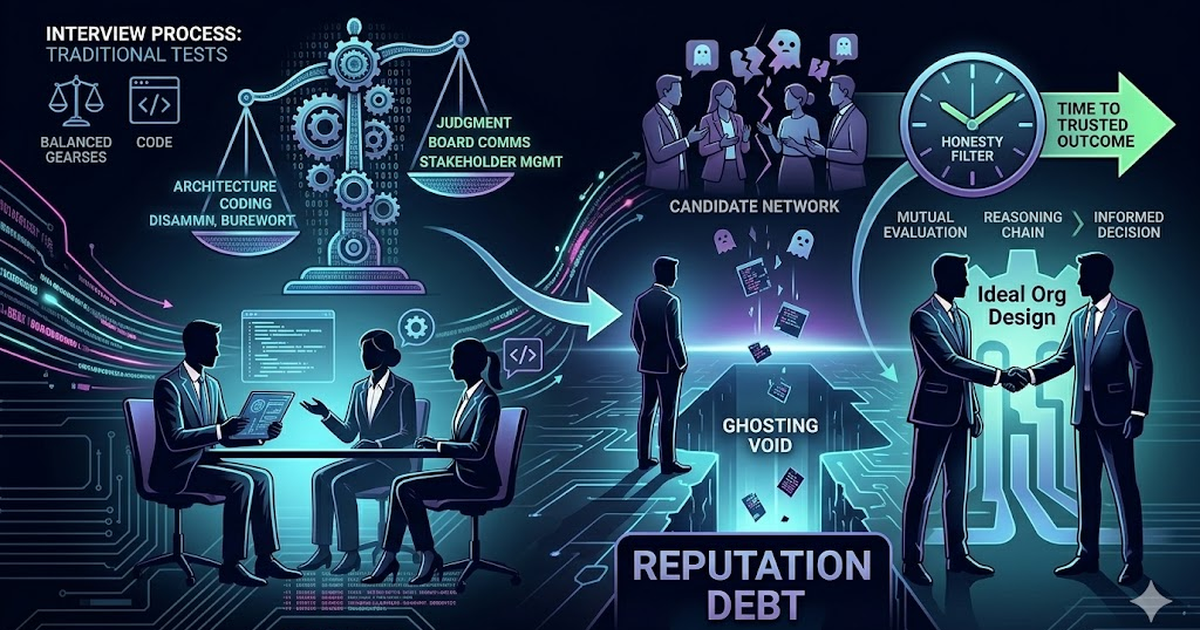
I've run hiring for 12 years. Three months ago, I sat on the other side of the table. Here's what the CTO market actually looks like from the candidate's chair.
I've run hiring for 12 years. First technical hire to a 15-person engineering org. Multiple rounds of Series B and C growth. I know what a broken process looks like from the inside - the handoff failures, the decision loops that nobody owns, the candidate who goes cold because nobody followed up.
Three months ago, for the first time in a long time, I was on the other side of the table. Thirty-plus interviews across multiple companies, search firms, and stages, a directional qualitative study, not a census of the CTO hiring market. Most processes were fine. A handful were exceptional. A few told me more about those companies than any due diligence session could have. And several ended in a way I had never personally experienced on this side of the table: not with a rejection - with silence.
This isn't a complaint. It's a market observation. And if you're running a senior technical hire in 2026, you need to hear it from the candidate's chair.
The CTO talent market is small, tight, and networked in ways that most TA teams don't fully model. Mistakes compound differently here than in volume hiring. What follows are the four patterns that separate the processes losing the best candidates from the ones that consistently close them.
The Ghosting Pattern Is Reputation Debt
Two rounds of interviews. Strong feedback both times. Then silence.
A week passes. You follow up. Nothing. Two weeks. Nothing. A month later: "We've paused the search."
This pattern played out across multiple processes during my three months on the candidate side. It's not unique to one company or one search firm. It's structural - and it's accelerating. According to iHire's 2026 research, 53% of job seekers were ghosted by an employer in the past year, up from 38% in 2024. The figure that landed hardest: 40% of candidates were ghosted specifically after a second or third round interview. Not after applying. After investing three to six hours across multiple sessions, preparing materials, aligning schedules.
The companies doing this aren't being cruel. They're avoiding a difficult conversation. A rejection email after two rounds requires someone to own the decision and deliver it clearly. Silence requires no one to do anything. It's a process failure disguised as inaction.
But here's what those companies don't account for: the CTO talent market is small, and the growth-stage slice of it is smaller still. CTO tenure splits sharply by company stage. At FTSE100 companies, the average sits at 4 years and 6 months (Vestd, 2025), longer than CFO or CMO. At growth-stage companies, Zippia's career data puts it closer to 1-2 years. The market this article is about is the latter. That shorter cycle means more frequent hiring events, a denser network, and shorter reference chains between candidates.
A company that ghosts a final-round CTO candidate in May might find that same candidate's former peer reviewing their VP Engineering hire in September. Or sitting across the table from their lead investor.
The silence doesn't disappear. It compounds. Senior technical candidates talk to each other in ways that don't show up in Glassdoor reviews.
The more important observation, though, is what the silence signals about internal operations. A company that can't send a rejection email after two rounds has a process problem that extends well beyond recruiting. Someone owns that candidate's experience. When no one acts, it means no one has enough clarity or authority to close the outcome. That's a culture preview, not just a hiring failure. The inability to deliver uncomfortable news in the recruiting process is exactly the same organizational dysfunction that shows up six months into the role when the CTO tries to push back on a product decision or tell the board that the roadmap doesn't add up.
If your process ghosts candidates, your internal communication has the same problem. The mechanism is identical.
The Interview Tests the Wrong Person
CTOs are interviewed like engineers. They're evaluated like CEOs. The process almost never bridges the gap.
The typical senior technical hiring process tests system design depth, architecture decision-making, and technical credibility under pressure. These are legitimate signals for a strong engineering leader. But the CTO job is something fundamentally different: stakeholder management, org design, fundraising narrative, board communication, and knowing when to slow the team down rather than push it forward. Almost no hiring process I encountered tested the second list. Almost every failed CTO hire fails on it.
Standard CTO interview - optimizes for the wrong signal
Round 1  System design - scale a URL shortener to 1B usersRound 2  Architecture depth - microservices vs monolith trade-offsRound 3  Technical leadership - how did you mentor your team?
Selects for:  engineering depth, technical knowledgePredicts:     strong staff engineer or engineering managerMisses:       commercial judgment, board dynamics, org resilience
Exceptional CTO interview - optimizes for the actual job
Round 1  When did you recommend against building something? What did it cost?Round 2  Describe a board conversation that went against you. How did you recover?Round 3  What's the most expensive technical mistake you made - what did the business pay?
Selects for: commercial judgment, stakeholder management, resiliencePredicts: CTO performance at Series B and beyondSignal: how the candidate answers reveals their self-awarenessThe tell is in the questions. A standard process asks: "Walk me through a technical decision you made." An exceptional process asks: "Tell me about a time you recommended against building something. What happened?"
The first question selects for engineers who ship things. The second selects for CTOs who understand when not to ship - which is often the harder and more valuable judgment. Saying no to a feature request from a founder who has conviction and urgency is a different skill set than designing a database schema. Almost no interview rubric evaluates it.
Three questions that consistently predict CTO performance, and that almost no one asks:
- "When have you slowed a team down and been right to do it? What did it cost you internally?"
- "Describe a board conversation where your recommendation was rejected. What did you do next?"
- "What's the most expensive technical decision your company made because of something you got wrong?"
These questions require vulnerability and commercial awareness simultaneously. Most interview processes don't have the structure to evaluate the answers well - which is exactly why they keep selecting for the wrong kind of CTO. The engineer who can go deep on architecture is much easier to assess than the executive who knows when to stop the sprint and have an uncomfortable conversation with the CEO.
Companies that design their CTO interview process around technical depth get technically deep CTOs. The role requires something harder to test and harder to fake.
ATS Friction Is a Culture Signal
Applied to thirty-plus roles across three months. Workday asked me to create a new account every single time.
This seems like a small thing. It isn't.
The ATS experience is, for many senior candidates, the first touchpoint with a company's internal operations. When the system is repetitive and clearly designed for recruiter workflow rather than candidate experience, it can signal something about how that company operates internally: a tendency to optimize for internal convenience over external experience. That's not a definitive inference, many broken ATS implementations are legacy decisions made by people long since moved on, but as a directional signal, it lands at the worst possible moment.
Companies invest heavily in customer UX - design sprints, user research, conversion funnels. The candidate experience frequently operates on a completely different standard. The form that asks for the same information five different ways. The "upload your CV, then manually re-enter everything" pattern. The apply button that leads to an error page. These aren't minor inconveniences for senior candidates evaluating roles. They're signals about operational quality that land at the worst possible moment: before the first conversation has happened.
The practical consequence is selection pressure running in the wrong direction. Senior candidates with multiple active processes deprioritize applications where the apply flow signals low operational competence. The companies with the most broken ATS experiences compete harder for candidates who have fewer alternatives - which is precisely the wrong filter for CTO-level search.
There's a simple audit available to anyone running an exec search: apply to your own open role, through your own ATS, from a private browser window. Fill in every field. Experience the confirmation email. The gap between what you believe the experience is and what it actually is tends to be instructive.
If you haven't done this, the experience your best candidates are having is unknown to you. That's a significant information gap to have in a small-market search.
Honesty Is the Fastest Filter You Have
I lost three offers this year for being too honest in interviews. Not strategic honesty - direct, specific assessments of what I was seeing, delivered in the room, in the moment.
What I actually said, verbatim:
"Your data pipeline isn't production-ready. That roadmap doesn't add up to the outcome you've described."
"You need 12 engineers to deliver this. You have four, and they're already at capacity."
"I'll need real authority over the technical stack - not just the title."
Each time, the energy in the room shifted. Each time, the rejection came within 48 hours. And each time - I already knew.
This isn't framed as a virtue story. I'm not presenting honesty as a character trait worth admiring. I'm presenting it as a diagnostic tool with extremely fast feedback loops.
The companies that leaned in after the first uncomfortable observation - that asked a follow-up question, pushed back constructively, or said "you might be right, tell me more" - were the processes worth continuing. Every single one of those companies had better questions, more direct feedback, clearer timelines, and more candid briefings from the search firm. Those signals weren't independent. They were different expressions of the same underlying culture: one that treats difficult information as useful rather than threatening.
The companies where the energy changed after the first honest statement were previewing the conversations that would happen six months into the role. When the CTO tells the board the product roadmap is overcommitted. When the CTO tells the CEO the engineering team needs three months to address technical debt before the next feature push. When the CTO tells the investors that the delivery timeline they've been given isn't grounded in reality.
How an interview panel responds to one uncomfortable truth is one of the most reliable signals available in a senior hiring process. The response is reproducible. It's not the candidate's honesty that's the filter - it's the company's response to it.
The honesty-as-filter framework works in both directions. Senior candidates who aren't honest in interviews will eventually land at companies that don't want honest feedback either. That's a hiring system working exactly as designed - just not toward the outcomes anyone intended.
What Great Actually Looked Like
A handful of processes were genuinely exceptional. Not exceptional in the way that sends a gift basket after the offer. Exceptional in the way that changes how you think about what a good process can be.
The differences were specific and repeatable across every process that stood out:
| Broken Process | Exceptional Process |
|---|---|
| Briefing is the pitch version of the company | Briefing names the real challenge the CTO is being hired to solve |
| Interview questions test technical depth | Interview questions test leadership judgment and commercial fluency |
| Silence after decision is made | Rejection or update sent within 48 hours, every time |
| Timeline stated once, never revisited | Timeline slippage communicated proactively ("going to be 3 weeks, not 2") |
| Candidate treated as someone to convince | Candidate treated as someone who needs to make a good decision |
| ATS optimized for recruiter workflow | Apply experience reflects the product quality the company claims to have |
Recruiters who briefed the actual challenge, not the pitch version. Not "we're a high-growth company building category-defining technology" - but "we have a CTO leaving after 18 months, the team is frustrated, and the board wants to understand why delivery has slipped." That level of transparency before the first call changes everything. It demonstrates that the company values an informed candidate over an impressed one. Those are different values and they produce different processes.
Interviewers who asked about failure, not just success. "What's the hardest feedback you've given to a founding team?" is a better CTO signal than "Tell me about your biggest delivery." The companies that asked about failure were the ones with the psychological safety to hear the answer. That safety doesn't emerge from culture decks or values posters. It shows up in how people run interviews - specifically, in whether they can sit with an uncomfortable answer without flinching or pivoting to something easier.
Timelines that were kept, or proactively updated when they slipped. "We said two weeks - it's going to be three" is a two-sentence message that most companies don't send. The ones that did built more credibility in those eight words than others generated across multiple interview rounds. Keeping a small commitment is proof that the organization can keep larger ones. Candidates notice this more than hiring managers expect.
The pattern across every exceptional process was consistent: they treated the candidate as someone who needed to make a good decision, not just someone they needed to convince. That's a fundamentally different starting assumption. It changes every interaction downstream - the quality of the briefing, the honesty of the questions, the speed of feedback, the precision of the offer.
Running the Audit on Your Own Process
The signals are observable before the search closes. Most companies don't look for them because they're evaluating candidates, not evaluating their own process. The ones that do close better candidates, faster, with fewer late-stage dropouts.
| Signal | Fix |
|---|---|
| Ghosting after round 2 | Assign one person to own every rejection. 48 hours maximum, no exceptions. |
| Timeline slippage without notice | One message when any date slips - before the candidate follows up. |
| High ATS friction | Apply to your own open role from a private browser. If it takes more than 8 minutes, fix it first. |
| Interview rounds test engineering depth | Replace one round with questions about judgment, failure, and board dynamics. |
| Briefing is the pitch version of the company | Name the actual problem the CTO is being hired to solve - before the first call. |
Scoring: Five broken signals means rebuilding the process before reopening the search. Three or four means fixing ghosting and the briefing first - highest ROI, fastest impact. One or two means sharpening interview question design. Zero broken signals is genuinely rare. Document what you're doing and use it as a hiring asset.
The CTO hiring market in 2026 is tilted toward employers. There are more senior candidates available than at any point in the last five years. That tilt makes it easy to treat process quality as optional - volume can mask dysfunction when the pipeline is full.
But the metrics that matter for senior hiring are not the same as the metrics that matter for volume hiring. A developer role receiving 500 applications can survive a broken ATS, a slow process, and an occasional ghost. A CTO search receiving 15 qualified candidates cannot. The error rate at that volume is simply too high. One failed close, one late-stage dropout, one candidate who deprioritizes you because your apply flow was broken - that's a meaningful percentage of your actual pool.
The companies I observed handling this well shared one assumption: the candidate they were trying to hire was simultaneously evaluating whether the company was worth their time. That mutual evaluation is what good CTO hiring feels like from both sides of the table. It's also rare enough to be immediately distinctive when it happens.
An employer's market doesn't make candidates disposable. It just makes it easier to behave as if they are.
Frequently Asked Questions
How common is candidate ghosting in senior hiring?
According to iHire's 2026 research, 53% of job seekers were ghosted by an employer in the past year, up from 38% in 2024. 40% were ghosted specifically after a second or third round interview, after already investing three to six hours across multiple sessions - not after simply applying.
Why does ghosting a CTO candidate matter more than ghosting other roles?
The CTO talent market is small and networked, and growth-stage CTO tenure runs closer to 1-2 years versus 4.5 years at FTSE100 companies, meaning roughly 2x more hiring events per decade. A company that ghosts a final-round candidate in May might find that same candidate reviewing their VP Engineering hire, or sitting across the table from their lead investor, months later. The silence compounds rather than disappearing.
Does a broken application process actually affect who accepts a CTO offer?
Yes. Senior candidates with multiple active processes deprioritize applications where the apply flow signals low operational competence - repetitive account creation, re-entering the same information, error pages. This creates selection pressure in the wrong direction: companies with the most broken candidate experience end up competing hardest for candidates who have the fewest alternatives, which is the wrong filter for CTO-level search.
What's the fastest way to filter a company during a CTO interview?
How the interview panel responds to one direct, uncomfortable observation - about the roadmap, the team's capacity, or the authority being offered. Companies that lean in, ask a follow-up question, or push back constructively are previewing a culture that treats difficult information as useful. Companies where the energy changes after one honest statement are previewing the same dynamic that will surface when the CTO has to tell the board the roadmap is overcommitted.
Why can't a CTO search tolerate the same process flaws as volume hiring?
A developer role receiving 500 applications can absorb a broken ATS, a slow process, or an occasional ghost. A CTO search receiving 15 qualified candidates cannot - one failed close or one late-stage dropout is a meaningful percentage of the entire pool. The error tolerance that's invisible at volume becomes decisive at the top of the funnel.
Sources
- iHire (2026). "53% of Job Seekers Have Been Ghosted by a Potential Employer."
- The Interview Guys (2025). "The 2025 Ghosting Index: How Employers and Candidates Are Disappearing From Each Other."
- Zippia (2026). "Chief Technology Officer Demographics and Statistics."
- Vestd (2025). "The C-Suite Churn Report 2025: FTSE100 retention and leadership."