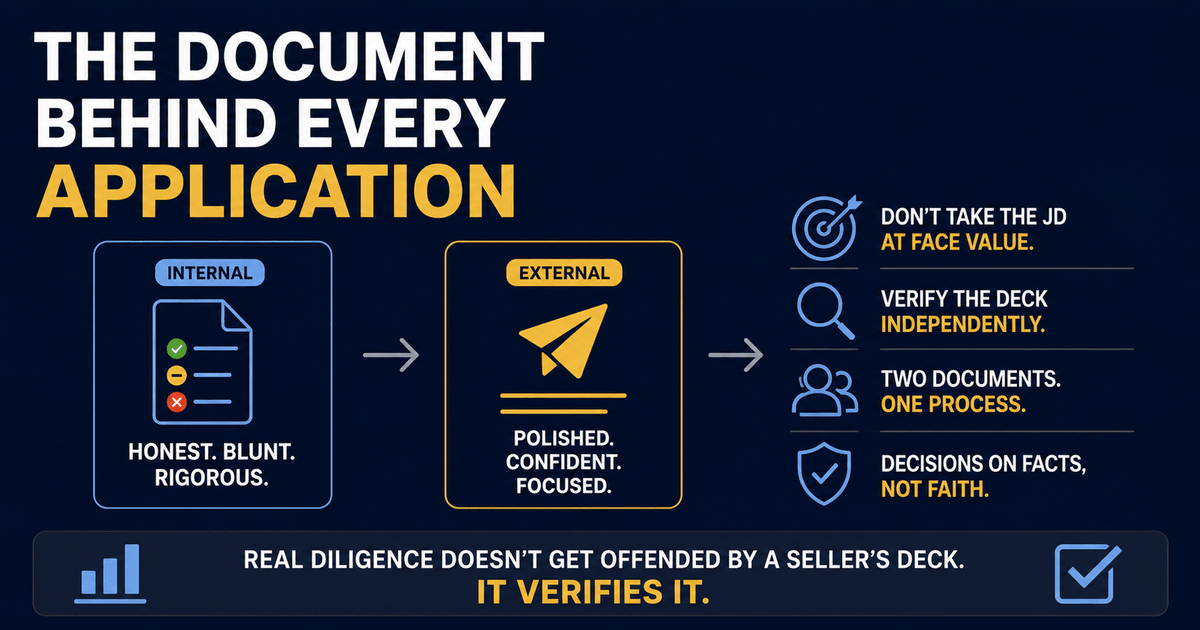
Every application I take seriously gets a document the recruiter never sees: a line-by-line map of what the role actually needs against what I can actually prove. That's half the process. Most people never run the other half.
The Document Behind Every Application
The file has a name: a requirement-by-requirement map, built for every role worth a second look, that never leaves my own drive. The rule behind it is the one that makes it worth building at all: no embellishment. Every claim traces to something true and already documented. Where the evidence is adjacent rather than direct, the document says so explicitly rather than stretching a connection to fill the row.
That's the honest version. What actually gets sent to a recruiter or a hiring manager is shorter, more confident, and stripped of the hedging - no gaps section, no "confirm before sending" scaffolding. Two documents, one internal and blunt, one external and polished, is a defensible split: you can't hand a company your own risk assessment unsolicited, that's not how the relationship works. But the split only stays honest if the rigor of the first one is what earns the confidence of the second - not spin layered on top of unresolved doubt. If the sent version wouldn't survive being read next to the internal one, the confidence isn't earned yet.
The practice only survives contact with a real search if it has somewhere to live, and the first rule of that structure is the same one real diligence follows: never work from a transcription of the source document, work from the source document itself. Postings get edited or pulled after the fact - if the only copy is something you retyped or summarized, you're diligencing your own memory of the claim, not the claim:
job-search/+-- applications/| +-- <company>-<role>/| | +-- job_description.pdf # the JD exactly as provided, saved not retyped| | +-- notes.md # recruiter contact, timeline, comp as relayed| | +-- case.md # internal only: requirement -> evidence map,| | | # materiality grade per row, named gaps| | +-- verification.md # independent findings: review sentiment,| | | # team tenure patterns, back-channel notes| | +-- pitch.md # external-safe: the version that gets sent| +-- closed/| +-- <company>-<role>/ # same five files, moved here once resolved+-- pipeline.md # one line per application: stage, next stepFive files, not one, and two of them exist specifically to keep the others honest. job_description.pdf stays unedited so case.md is always graded against what the company actually wrote, not a paraphrase that's quietly drifted toward whatever makes the match look cleaner. case.md and verification.md stay separate for the same reason - one is what you can prove about yourself, the other is what you independently confirmed about them, and collapsing them into a single document is how people end up grading their own resume against the JD and calling it diligence. pipeline.md is the only file that has to stay current; the rest are written once, at the point a role is worth the hour it takes.
The JD Is a Pitch Deck, Not Audited Financials
Read the numbers on job postings and the instinct is to feel deceived. Greenhouse's 2025 platform data puts the ghost-job rate at 18% to 22% of postings in any given quarter. Clarify Capital's January 2025 survey of 1,000 employers found nearly 1 in 3 admit posting a role with no current intent to hire. LiveCareer's March 2025 survey of 918 HR professionals found 45% regularly post ghost jobs and another 48% do it occasionally - 93% acknowledging the practice to some degree.
That's the wrong read. A job posting was never a factual document - it's a pitch deck, written by the party with every incentive to present the best version of the opportunity. Treating that as personal betrayal misses the more useful frame: this is the base rate for information asymmetry in any document one side writes to persuade the other. Real diligence doesn't get offended by a seller's deck. It assumes the deck is optimistic and builds a process that doesn't depend on it being accurate.
The postings that are real still frequently misrepresent the role. Resume Genius' 2026 Hiring Trends Report, reported by Forbes, surveyed 1,500 US hiring managers: 64% admit their own company misrepresented some aspect of a role or the hiring process, most commonly understating the actual difficulty or team environment. ZipRecruiter's Q2 2026 survey of more than 1,500 recent hires found 15% said the original job description barely matched or failed to reflect their actual role, and 26% said a mismatch like that would make them restart their search.
None of this is a reason to distrust every posting. It's a reason to never let the posting be the only document under scrutiny - which is exactly the workstream most job-search advice skips entirely.
Exploratory vs. Confirmatory: Verifying the Deck Independently
Private equity due diligence runs in two phases, and the distinction matters here. As M&A Science's Kison Patel describes it, exploratory diligence happens early, scoped to whatever the seller provides, aimed at finding deal-breakers fast enough to avoid wasting time on a dead opportunity. Confirmatory diligence happens later, once both sides are seriously engaged, and it doesn't just re-read the seller's materials more carefully - it goes and checks them against something the seller didn't hand over.
That second phase is the one missing from how most people evaluate a job. Requirement-by-requirement self-assessment against the JD is real work, but it's still entirely inside the deck the other side wrote. Independent verification means checking claims against sources the company didn't curate for you: review-site sentiment for the specific team, not the company in aggregate; LinkedIn tenure patterns for the role's last two or three occupants, since three people in two years in the same seat is a materially different signal than one person for four; and a back-channel reference through your own network, not just the recruiter's summary of the manager you'd report to.
A requirement-to-evidence map only tells you whether you match the pitch deck. It tells you nothing about whether the pitch deck was accurate. Those are two different questions, and most people only ever ask the first one.
Glassdoor's 2025 employer branding research puts the base rate for this behavior at 86% of candidates checking reviews before applying - though the source itself notes the self-reported figure likely overrepresents people who were already active review consumers, worth stating plainly rather than letting the number imply more precision than it has. The instinct is common. What's uncommon is treating it as a formal second workstream, run in parallel with the self-evidence map, rather than a five-minute Glassdoor skim done once and forgotten.
The Requirement-by-Requirement Map
The self-evidence side is mechanical once the discipline is in place: read every stated requirement as a claim, then write down real evidence or admit there isn't any. Grade it honestly - direct match, adjacent, partial, no match - and don't round up.
A worked example, using nothing beyond what's already public: a requirement to own a data platform's architecture end to end maps to a direct match - as CTO at McKenzie Intelligence Services, that ownership cut cloud infrastructure cost 60% and took delivery from once every 3-6 months to every 1-2 weeks within a year, detailed in how I increased delivery speed by doing less, not more. A requirement for formal data-governance or semantic-layer ownership maps differently: no role has carried that title by name, but the discipline behind building a SaaS metrics stack investors could actually trust is the same underlying skill, exercised at Series B-D fundraising stakes and documented in the data room that helped close a Series B. That's adjacent, not direct - and the map says so, rather than letting "data governance experience" sound more literal than it is.
The map doesn't end at self-knowledge, and treating it as a private clarity exercise wastes half its value. Every honestly-graded row converts directly into a specific, askable question for the next call - "you'll notice I've never held a role with this exact title, here's the closest analog, does that discipline map to what you actually need" - instead of a vague unease you can't articulate until you're six weeks into a job that isn't what you thought.
Materiality, Not Just a Gap List
A flat list of gaps is only half a diligence process. Real M&A findings get classified by consequence, and Kison Patel's framework maps cleanly onto a job search: manageable findings get addressed through negotiation, the equivalent of a clause in a contract. Significant findings reopen terms - the price moves, or in this case, the scope, the reporting line, or the comp conversation changes. Deal-breakers are unsolvable, and the buyer walks.
Most self-assessment collapses this into one bucket. "No role has been called this by name" and "no experience with the platform's underlying technology at all" are not the same finding, but a flat gap list treats them identically - both just items on a list of things you don't have. One is a footnote worth raising in conversation. The other is a deal-breaker no amount of reframing closes. Conflating the two is the actual failure mode of most self-assessment, not the gap itself.
A Process That Can't Say No Isn't Diligence
The entire value of running this as a real process rather than a confidence-building ritual is that it has to be structurally capable of producing "don't take this." Without that capability, it's a well-organized way of talking yourself into a role you'd already decided you wanted - every "adjacent" reframed as close enough, every gap explained away rather than graded.
Naming a deal-breaker plainly in the internal document, even when it's uncomfortable, is what makes the version you actually send honest by construction rather than by effort. You're not hiding the gap from the recruiter. You already decided, on paper, that it wasn't disqualifying - and that decision is exactly what lets the sent version read confident without reading defensive. A pitch that's confident because the doubt was resolved earlier is different from a pitch that's confident because the doubt was never written down.
What Skipping This Costs Everyone
This isn't just risk management for the candidate. ZipRecruiter's Q2 2026 data shows the downstream cost on both sides of a mismatch: 78% of dissatisfied new hires plan to leave within a year, against 48% of very satisfied hires who expect to stay five or more years. A materially mismatched hire is expensive for the company too, not a private inconvenience that only lands on the person who took the job.
The market's own response to this is visible in legislation, not just survey data. As of mid-2026, 13 states plus DC require salary ranges directly in job postings, and 18 states plus DC have some form of pay-transparency requirement. That's employers being told, by law, to close exactly the kind of information gap a vague posting used to leave open by default.
A diligence process that only ever produces yes was never actually diligence. It was a well-organized way of agreeing with a decision that had already been made - and the discipline of building one that can say no is the only part of this that was ever actually about honesty, for either side of the table.
Sources
- Greenhouse - 2025 Workforce & Hiring Report - platform-level ghost-job rate data
- Clarify Capital - Job Seekers Beware of Ghost Jobs Survey (January 2025) - 1,000-employer self-reported survey on posting intent
- LiveCareer - HR Professionals Admit to Posting Ghost Jobs (March 2025) - 918 HR professionals surveyed
- Forbes, reporting Resume Genius' 2026 Hiring Trends Report - 1,500 US hiring managers on role misrepresentation
- ZipRecruiter Economic Research - New Hire Survey, Q2 2026 - 1,500+ recent hires on JD accuracy and retention intent
- M&A Science (Kison Patel) - Confirmatory Due Diligence - exploratory vs. confirmatory phases and the materiality classification framework
- Glassdoor 2025 employer branding research, via Employer Branding News - candidate review-checking behavior, with the source's own self-selection caveat
- Paycor - 2026 Pay Transparency Laws by State - state-by-state salary disclosure requirements