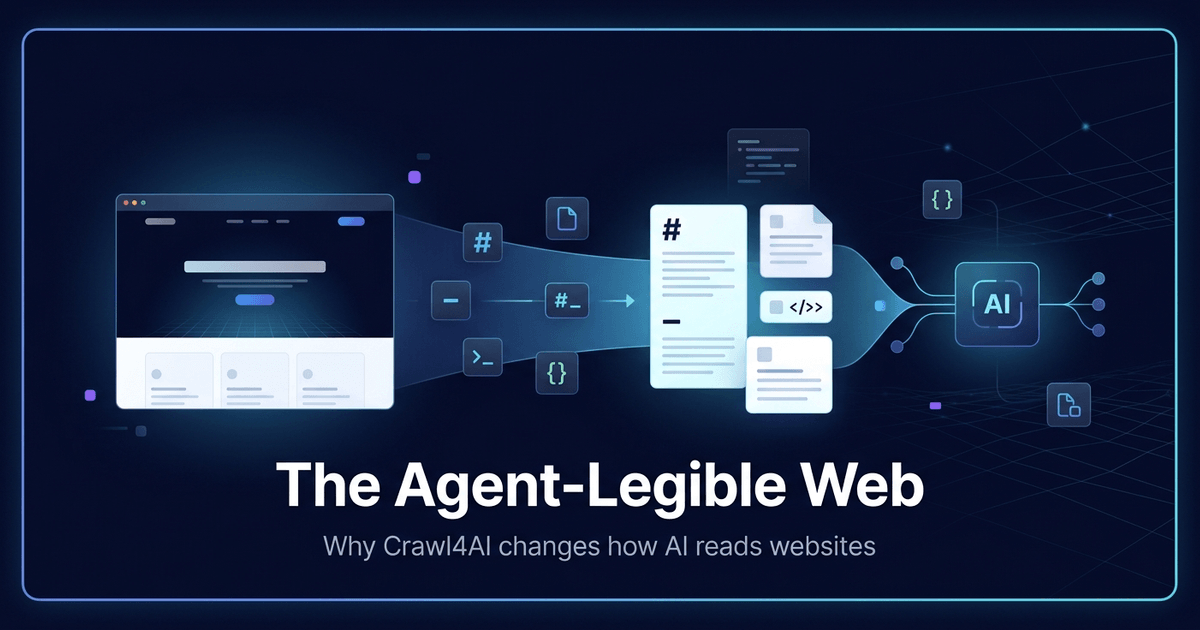
BeautifulSoup scrapes pages. Crawl4AI assumes no one reads them.
That's the distinction underneath a project that went from a solo repository to 75,000 GitHub stars in about three years. Crawl4AI converts a web page into clean, LLM-ready markdown: navigation stripped, ads gone, links converted into a numbered citation list, ready to hand to an agent or a retrieval pipeline. The framing on its own README is direct about who it's for: "RAG, agents, and data pipelines," not browsers. Most coverage of the project treats that as a feature list. It's closer to a diagnosis.
Access was never the problem
Getting a program to reach a web page has been a solved problem since before most agentic AI engineers were writing code. Leonard Richardson released Beautiful Soup in 2004, built to scrape structured data off e-commerce sites like Amazon. Four years later, a London startup called Mydeco open-sourced the crawler prototype Shane Evans had built for it, and Pablo Hoffman's team in Montevideo shipped it as Scrapy 0.7 in August 2008. Both tools solved the same problem: parse HTML, follow links, extract structure, without the target site's cooperation.
The web's own machine-access contract is older still. Martijn Koster's Robots Exclusion Protocol dates to 1994, and by that June it was already a de facto standard that WebCrawler, Lycos, and AltaVista complied with. It took until September 2022 for the IETF to formalize it as RFC 9309, but the underlying deal, "here's what a crawler may touch," was functioning three decades before an LLM ever tried to read a page. Access, in other words, is not the gap Crawl4AI closes. That gap closed in 2008.
What changes when the reader is a model, not a browser
A human skimming a product page filters the cookie banner, the nav bar, and the "you might also like" carousel without conscious effort. A model doesn't get that filter for free. Every token of chrome an agent ingests is a token it isn't spending on the content that actually answers the question, and the effect isn't cosmetic. A 2026 study across long-context and retrieval-augmented setups found that LLM accuracy degrades 13.9% to 85% as input length increases, even when retrieval is perfect and every relevant fact is present. The model doesn't need to be missing the answer. It needs to be buried in enough surrounding noise, and performance falls anyway.
Access was solved by parsing HTML. Legibility requires deciding, at scale and without human judgment, what in that HTML is worth a model's attention. Those are different engineering problems, and the tooling built for the first one was never built to solve the second.
That's the operational version of "the web was built for humans." It isn't a complaint about advertising. It's a measurable cost: every unfiltered navigation menu and boilerplate footer that reaches a context window is diluting the signal an agent is meant to reason over, on a curve where the damage compounds rather than plateaus.
Fit Markdown and the citation list: what "legible" actually means
Crawl4AI operationalizes the distinction with two specific mechanisms, not a marketing phrase. Fit Markdown runs a heuristic filter, documented as scoring content blocks on text density, link density, HTML structure, and known boilerplate patterns like "nav" and "footer," then discarding blocks that score below threshold. A second mode, BM25 filtering, keeps only sections relevant to a supplied query. The project ships both a raw and a filtered markdown output, so the filtering is a choice, not a black box.
The second mechanism addresses a narrower but real problem: provenance. Inline links in a scraped page normally collapse into either dead text or an unreadable wall of URLs. Crawl4AI converts them into footnote-style citations, `[text][1]`, with the actual URLs aggregated at the end of the document. For an agent that needs to tell a user where a claim came from, that's the difference between a traceable answer and a fabricated-sounding one. It's a small mechanism, but it's the one that turns "the agent read the web" into "the agent can show its work."
Depth is a feature, not a workaround
A human researching a topic doesn't stop at one page. They click through, follow the thread three or four links deep, and build a mental map of the site along the way. Most scraping tools treat that as an application-layer problem, something you script yourself with a queue and a visited-set. Crawl4AI ships breadth-first-search deep-crawling as a first-class strategy, with crash recovery and a prefetch mode the project documents as five to ten times faster than full-page processing during the discovery phase.
That's a second axis of the same access-versus-legibility argument. Fetching one URL was never the hard part. Traversing a site the way a human would, and doing it reliably enough that a crash three levels deep doesn't silently truncate the dataset, is closer to what "reading the web" actually requires for an agent that has to synthesize across pages rather than answer from one.
The Docker playground and the collapse of "roll your own client"
Crawl4AI's Docker deployment ships a real-time monitoring dashboard and an interactive playground for testing extraction configs before writing a client. That's a maturity signal worth naming directly: the project stopped being a library you `pip install` and started being infrastructure you deploy. The same pattern played out with data orchestration, where Airflow, Prefect, and Dagster all moved from "a scheduler you script against" to "a platform with a UI, a dashboard, and an API surface." Tools mature into infrastructure once enough teams are running them in production to need visibility into what's actually happening, not just a script that either finishes or doesn't.
The honest caveat belongs here, not in a footnote. Fit Markdown's filtering is a heuristic, not a guarantee. Text-density and link-density scoring, tuned against typical page layouts, will misclassify content on sites that don't match the pattern, a single-page app with unusual DOM structure, a page where the "boilerplate" happens to carry the answer. Any team routing production RAG traffic through it needs a validation step on their actual document distribution before trusting the filtered output, the same discipline that applies to any heuristic parser, agentic or not.
Why this one, and what the star count actually measures
The comparison that matters isn't Crawl4AI's raw star count against older tools. It's the count relative to time in existence.
Normalized for age, the gap widens further. Crawl4AI is accumulating roughly 25,000 stars per year against Scrapy's lifetime average of about 3,500 and Playwright's roughly 14,000, a velocity around seven times Scrapy's pace and nearly double Playwright's, despite Playwright solving a harder, more general problem (full browser automation, not just extraction).
A star count that fast usually means one of two things: a better version of an existing category, or a new category nobody had named yet. Scrapy and BeautifulSoup didn't lose users to Crawl4AI, their download numbers and issue trackers show no such migration. What happened instead is the founding-year gap itself became the argument.
The stars aren't proof that Crawl4AI is a better tool than Scrapy. Scrapy still wins on raw crawling throughput and ecosystem maturity for classic data-extraction jobs. The stars are evidence of a job-to-be-done that didn't exist for either tool's original audience: not "get me the data," but "get me the data in a shape a model can use without drowning in what surrounds it." That's a market signal, not a popularity contest, and reading it as the second thing understates what it actually shows.
The open question this leaves isn't whether the web needs a legibility layer for machine readers. The star count already answered that. It's whether that layer stays open infrastructure, one repo, one license, inspectable by anyone routing production traffic through it, or gets absorbed by whichever platform decides it should own the crawl. Access was a protocol fight in 1994. Legibility is shaping up to be an infrastructure fight in 2026, and who wins it will matter more than which scraper tops the trending page next.
Sources
- unclecode - Crawl4AI GitHub Repository (2026) - project README, star count, Fit Markdown and deep-crawl feature documentation
- Crawl4AI Documentation - Markdown Generation (2026) - Fit Markdown heuristic filtering, PruningContentFilter and BM25ContentFilter mechanics
- Scrapy - GitHub Repository - current star count and project overview
- Zyte - The Rise of Scrapy: How an Open-Source Scraping Framework Conquered the Web - Scrapy's 2007-2008 origin, Shane Evans, Pablo Hoffman, and Insophia
- Microsoft - Playwright GitHub Repository - current star count and project overview
- Wikipedia - Playwright (software) - January 2020 release date
- Leonard Richardson - Beautiful Soup Project Page - 2004 origin and project history
- Wikipedia - Robots.txt - Martijn Koster's 1994 Robots Exclusion Protocol and its adoption by early search crawlers
- IETF / RFC Editor - RFC 9309: Robots Exclusion Protocol (2022) - formal standardization of the 1994 protocol
- Du et al. - Context Length Alone Hurts LLM Performance Despite Perfect Retrieval (arXiv, 2025) - 13.9%-85% accuracy degradation from input length independent of retrieval quality